
Patio cleaner buying guide
Best patio cleaners for common outdoor staining
Compare patio-cleaning products for everyday paving grime, biological growth and black spots, with clear surface, application and runoff checks.
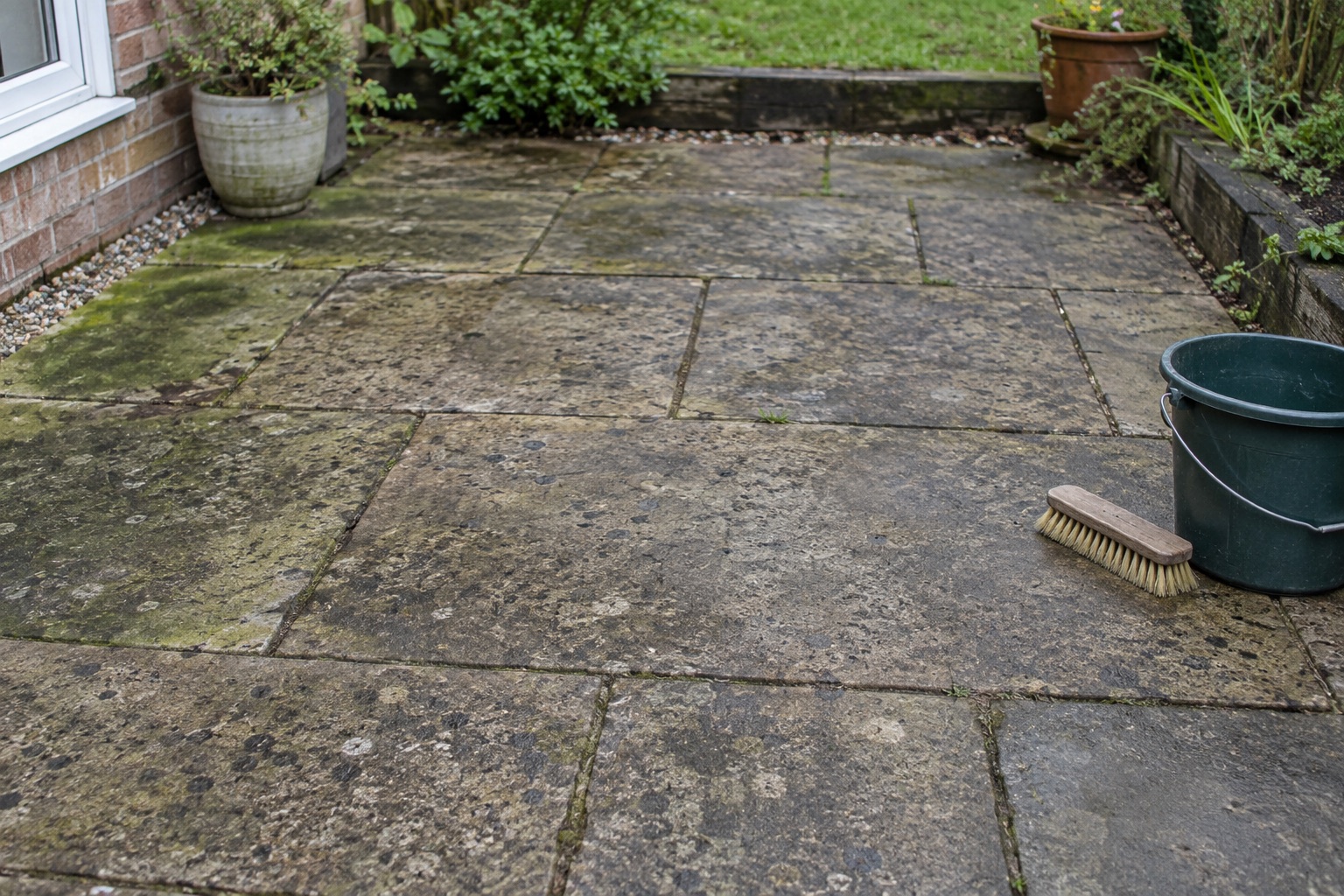
Three different products for three different jobs
“Patio cleaner” describes a shelf category, not a single problem. Dull grey soil, green film and hard black dots have different causes and need different decisions. Our choices illustrate three useful formats rather than claiming one bottle wins every patio. Start by brushing away loose grit and testing a small area with water. If that works, you may not need a chemical at all.
HG Patio-Tile Cleaner is the general-grime option for the gravel and concrete tiles or other paving permitted by its label. It is diluted, scrubbed and rinsed. Wet & Forget Outdoor is a diluted, leave-on treatment for eligible outdoor growth; it needs suitable dry-weather conditions and should not be put through a pressure washer. SCRUBB Black Spot Remover targets stubborn black spots on label-approved paving, not ordinary dust. Its stronger purpose calls for particular care with material approval, protective equipment and runoff.
 View product on Amazon
HG Patio-Tile Cleaner 1L
Best for: Gravel and concrete patio tiles and other paving approved by the label
A concentrated brush-on cleaner for ordinary grime on the patio materials named by HG. It is not a black-spot, rust or oil-stain treatment.
Pre-wet, dilute, scrub and rinse according to the current bottle; do not assume suitability for limestone or an unidentified sealed finish.
- 1 litre
- Concentrate
- Gravel and concrete tiles
- Brush and rinse
 View product on Amazon
Wet & Forget Outdoor Cleaner 5L
Best for: Label-approved outdoor surfaces with algae, mould or lichen
A concentrated outdoor treatment for organic growth on many exterior surfaces. It is a treatment, not an instant pressure-washing substitute; follow the label for dilution, weather and runoff.
Check the exact surface and any sealer with the maker before use; keep it out of ponds and follow plant and pet precautions.
- 5 l concentrate
- Outdoor surfaces
- Organic growth
- Label-led dilution
 View product on Amazon
SCRUBB Black Spot Remover 5L
Best for: Black-spot treatment on manufacturer-approved exterior masonry
A specialist black-spot treatment intended for exterior masonry. Confirm your paving and any sealer are approved, then patch test and follow the safety, contact-time and runoff instructions.
Do not assume suitability for limestone, porcelain or a coated surface without explicit maker confirmation.
- 5 l
- Exterior masonry
- Patch test
- Follow label
Surface approval matters more than a five-star label
Before ordering, name the paving: concrete slab, porcelain, sandstone, limestone, block, resin or something else. Check any sealer and pointing as well. A product's broad marketing language does not replace its current bottle directions or the paving maker's care requirements. Acid-sensitive stone and fragile mortar deserve particular caution. For limestone, start with the limestone guide; for sandstone, use the sandstone guide. For black spots and algae, the dedicated black-spot and algae pages explain the differences.
Oil on a driveway and rust under metal furniture are not reasons to buy a larger bottle of general cleaner. Use the oil or rust diagnosis instead.
Plan the whole job, including the water
Read the exact current label for dilution, dwell, weather, rinse requirements and protective equipment. Test discreetly and allow the test to dry. Keep children and animals off the treatment area as instructed, prevent drift to plants and ponds, and never mix chemicals. Rinse-off cleaner produces wastewater; even a leave-on treatment must not be allowed to enter a drain or watercourse. If you cannot control the route, postpone the chemical work and try a lower-water manual method.
A pressure washer is a separate tool for suitable robust paving, not a substitute for stain diagnosis. See patio cleaner versus pressure washing and the safe application method.
How much patio cleaner should you buy?
Measure the area you intend to treat, not the entire plot. A coverage figure quoted for a bottle normally refers to that bottle's product at the stated dilution—not to each litre of the resulting mix. Keep the product quantity, added water and rinse-water requirement separate.
Plan the amount
Treatment quantity planner
Use the measured area and coverage in square metres per litre of product. Coverage for one coat and coverage for a complete multi-coat system are different: do not count the coats twice.
Approximately 25 m² per 1 litre bottle of concentrate at its labelled 1:4 product-to-water dilution. Coverage is approximate; do not divide by the five litres of mixed solution. HG UK bottle label, checked September 2026.
Example: 40 m², no extra allowance
- Calculated product at this coverage
- 1.6 litres product
- Whole packs to purchase at this rate
- 2 × 1 litre packs
- Product in those packs
- 2 litres in whole packs
40 m² ÷ 25 m²/l = 1.6 litres.
Approximately 25 m² per 1 litre bottle of concentrate at its labelled 1:4 product-to-water dilution. Coverage is approximate; do not divide by the five litres of mixed solution. Pack counts use unrounded quantities; actual consumption can differ.
This is a buying estimate, not an application instruction or readiness check. Surface texture, absorption and losses can reduce coverage. Do not stretch a product by adding water, under-coating or exceeding its application rate.
| Treated area | Calculated product | Whole 1 litre packs |
|---|---|---|
| 20 m² | 0.8 l | 1 |
| 40 m² | 1.6 l | 2 |
| 60 m² | 2.4 l | 3 |
A bottle's coverage is not a promise
For the HG example, 40 m² ÷ 25 m² per litre of concentrate gives 1.6 litres of product, so two 1 litre bottles at the approximate label rate. The mixed liquid is a separate quantity, calculated at the bottle's ratio. Surface texture, application losses and actual staining can change consumption.
For another cleaner, use its current coverage and pack size rather than borrowing HG's figures. If a label provides only “up to” coverage, the result is a best-case quantity; if it provides no coverage, this planner cannot invent one. Work in small, controlled batches using the label-based dilution calculator. Do not stretch coverage by under-dosing or increase strength to tackle a different stain.
Frequently asked questions
Which patio cleaner removes green algae?
A growth treatment approved for the specific paving, such as Wet & Forget Outdoor where its current label permits, is more relevant than a general grime cleaner.
Will a general cleaner remove black spots?
Not reliably. Confirm the marks are black-spot growth, then consider a labelled specialist treatment.
Is the strongest cleaner best?
No. Greater chemical strength can raise damage and runoff risk without addressing the cause.
Can I use these on natural stone?
Only when the current product label and stone supplier both allow that exact material and finish.
Should I pressure wash after a leave-on treatment?
Follow that product's instructions. A leave-on treatment should not be immediately washed away merely to speed the job.