
Garden sizing guide
What size pressure washer does your garden need?
Match pressure, flow, hose reach and machine format to your garden size, surfaces and access rather than buying from bar alone.
The AVA Go P40 Medium's eight-metre hose and named accessory bundle illustrate why working reach and included equipment matter alongside a pressure figure. See AVA's bundle details.
Start with the job
Garden size is only the first measurement
Two gardens with the same footprint can need different machines. A lawn-heavy garden with a bicycle and a few chairs asks for controlled rinsing. The same area covered in sound concrete slabs asks for sustained water flow and a practical surface-cleaner option. List the surfaces, the area that is genuinely washable and how often each job occurs before comparing machines.
Pressure loosens dirt; flow carries it away. Hose length determines whether the machine can remain stable while you work. Those three factors should be read together. Maximum bar on its own says little about the time required to rinse a patio or the care needed around timber, pointing and vehicle trim.
| Garden and regular jobs | Useful format | Pressure range | Flow and reach | Main compromise |
|---|---|---|---|---|
| Courtyard or small terrace | Compact mains or portable cleaner | 20–120 bar depending on job | Prioritise 6–8 m working reach | Portable formats are slower on paving |
| Small mixed garden | Compact controllable mains | About 120–135 bar max | Roughly 390–450 l/h and 7–8 m hose | Check storage for the complete kit |
| Medium mixed garden | Adjustable mains trolley | About 120–140 bar max | Roughly 420–465 l/h with planned reach | Heavier machine and more setup |
| Large paved garden | Sustained mains output plus matched attachment | Control matters more than headline maximum | Higher useful flow and enough hose for zones | Longer sessions and drainage planning |
Courtyards and small gardens
Choose control and reach before raw output
For a compact patio, furniture, bins and occasional car cleaning, a small mains washer is usually the most versatile choice. The AVA Go P40 combines a compact body with an eight-metre hose; the Bosch UniversalAquatak 135 is slightly larger but adds useful flow. Both avoid buying a large trolley merely to clean a modest area.
If the garden has no outdoor tap, the definition of “right size” changes. A tank-fed Bosch Fontus or bucket-fed Worx HydroShot can be more usable than a stronger machine that cannot be supplied safely. Expect shorter sessions and slower paving work.
 View product on Amazon
AVA Go P40 Medium
Best for: Cars, bikes and smaller outdoor areas where storage space is tight
A genuinely compact 120-bar mains washer with an 8 m flexible hose and 390 l/h flow. The small body and stored accessories make it appealing for sheds, garages and mobile car-care setups.
What stands out
- Compact body with stored accessories
- 8 m flexible hose
- Ten-year warranty when registered under AVA's terms
Keep in mind
- No surface cleaner in the Medium bundle
- Lower flow than the mid-range corded leaders here
- 120 bar max
- 390 l/h
- 8 m hose
- Mains · 1.7 kW
 View product on Amazon
Bosch Fontus 18V
Best for: Cars, bikes and furniture where a tap or socket is inconvenient
A wheeled cordless outdoor cleaner with a 15-litre built-in tank, adjustable output and four spray patterns. Its 20-bar pressure suits controlled rinsing rather than large-patio restoration.
What stands out
- 15-litre built-in water tank
- Four spray patterns
- Up to 60 minutes quoted with the recommended battery
Keep in mind
- The selected Amazon listing excludes battery and charger
- 20 bar is not intended for heavy paved-area cleaning
- 20 bar max
- 15 l tank
- 4 m hose
- 18 V battery
Mixed medium gardens
A controllable mains machine is the useful middle ground
A medium garden commonly combines patio, paths, furniture, fencing and perhaps a car. An adjustable mains machine around 120–140 bar with roughly 400–465 l/h flow covers that range without forcing every job through one aggressive nozzle. Seven metres of hose is workable when the machine can move; eight metres is more forgiving around furniture and corners.
The Kärcher K 4 Power Control Flex gives eight metres of flexible hose and adjustable output. The Bosch UniversalAquatak 135 is lighter and has a strong listed flow rate, but its seven-metre hose needs more deliberate placement. Neither specification makes fragile stone or weathered timber automatically safe.
 View product on Amazon
Kärcher K 4 Power Control Flex
Best for: Mixed household cleaning where control and an 8 m flexible hose matter
A balanced mains machine for patios, cars and general outdoor work. Its useful advantage is not extreme pressure but adjustable output, a flexible 8 m hose and a stable mid-range flow rate.
What stands out
- 20–130 bar adjustment
- 8 m PremiumFlex hose
- 420 l/h maximum flow
Keep in mind
- The base package does not include a surface cleaner
- At 12.1 kg before accessories it is not the lightest option
- 20–130 bar
- 420 l/h
- 8 m hose
- Mains · 1.8 kW
 View product on Amazon
Bosch UniversalAquatak 135
Best for: Smaller homes wanting one compact machine with a multi-pattern nozzle
A compact 135-bar washer with a strong 450 l/h maximum flow and a practical three-in-one nozzle. It reduces attachment swapping for routine car, furniture and small-patio jobs.
What stands out
- 450 l/h maximum flow
- Three spray patterns in one nozzle
- 7.9 kg machine weight
Keep in mind
- No surface cleaner in the standard box
- The 7 m PVC hose is shorter and less flexible than some rivals
- 135 bar max
- 450 l/h
- 7 m hose
- Mains · 1.9 kW
Large or paving-heavy gardens
Cleaning speed depends on sustained flow and workflow
For a broad patio, long paths or several zones, a mains machine is normally the realistic choice. Higher flow improves rinsing and helps a correctly matched surface-cleaner head work consistently. Divide the garden into sections, sweep first, identify drainage and keep dirty water moving away from already cleaned areas.
Do not automatically choose the strongest rotary jet. Old joints, loose pointing, soft stone, coated decking and cracked concrete can all be damaged. A wider fan, greater working distance and slower repeat passes are often the better route.
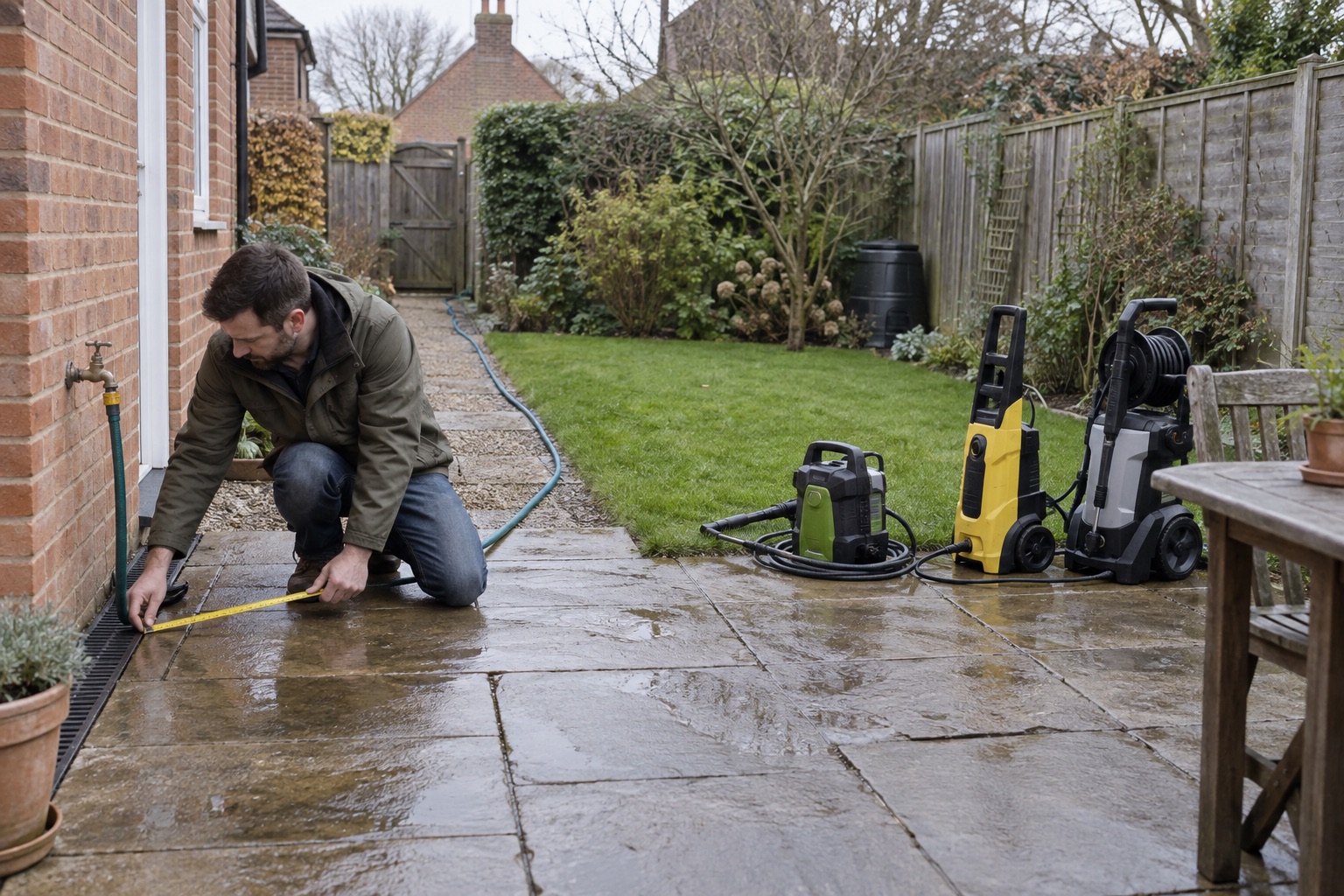
Measure the real working route
- Start at the water source: include the supply hose and any permitted connector.
- Locate protected power: outdoor electrical equipment needs an appropriate supply and RCD protection.
- Walk to the furthest point: include corners, gates, steps, parked cars and furniture.
- Add movement around the object: cleaning a car requires reach around it, not just to it.
- Plan storage: measure the washer, hose, gun, lance, battery, charger and attachments together.
For a fuller equipment decision, use our home-and-garden pressure-washer guide. If access is the deciding factor, compare portable pressure washers and the options for cleaning without an outside tap.
Frequently asked questions
Is 120 bar enough for a garden?
It can be enough for cars, furniture and a modest area of sound paving when paired with reasonable flow and the correct nozzle. Surface condition matters more than chasing a larger number.
What flow rate is useful for patio cleaning?
Many capable domestic mains machines sit around 390–465 l/h. Higher flow generally improves broad-area rinsing, but water supply, drainage and safe surface pressure still limit the job.
How long should the pressure-washer hose be?
Seven metres works in many small gardens; eight metres gives more freedom around cars and furniture. Measure the routed distance rather than the straight line.
Can one pressure washer clean every garden surface?
No. A versatile machine still needs the correct nozzle, distance and pressure. Some fragile, damaged or coated surfaces are better cleaned by hand or by a specialist.
Do small gardens need cordless pressure washers?
Only when tap, socket or storage access makes mains equipment awkward. A compact mains washer is usually faster where safe connections are available.