
Cordless car-care guide
Best cordless pressure washers for cars
Cordless car-cleaning options compared by water supply, control, portability, battery setup and safe use around paint, seals and sensors.
Useful products for the job
Add a proper contact-wash stage
Portable cleaners are good rinsing tools, but a car-safe shampoo still matters for bonded road film.
 View product on Amazon
Autoglym Bodywork Shampoo Conditioner 2.5L
Best for: Contact washing after a careful vehicle pre-rinse
A car-specific shampoo for the bucket-wash stage. Rinse loose grit first, dilute as directed and use a clean wash mitt instead of relying on pressure to remove bonded road film.
A useful companion to a gentle pressure washer or portable rinsing tool, not a product for patios or decking.
- 2.5 l
- Car bodywork
- Dilute for bucket wash
- Rinse after washing
Bosch lists a 15-litre built-in tank and adjustable spray patterns for the Fontus 18V, but offers both tool-only and battery-and-charger packages. Compare Bosch's Fontus packages.
Two access-led choices
Tank-fed convenience or bucket-fed portability
The Bosch Fontus keeps its water on board and rolls into position, reducing loose equipment. It suits an ordinary driveway where the machine can remain near one side of the car. The four-metre hose may require repositioning around larger vehicles.
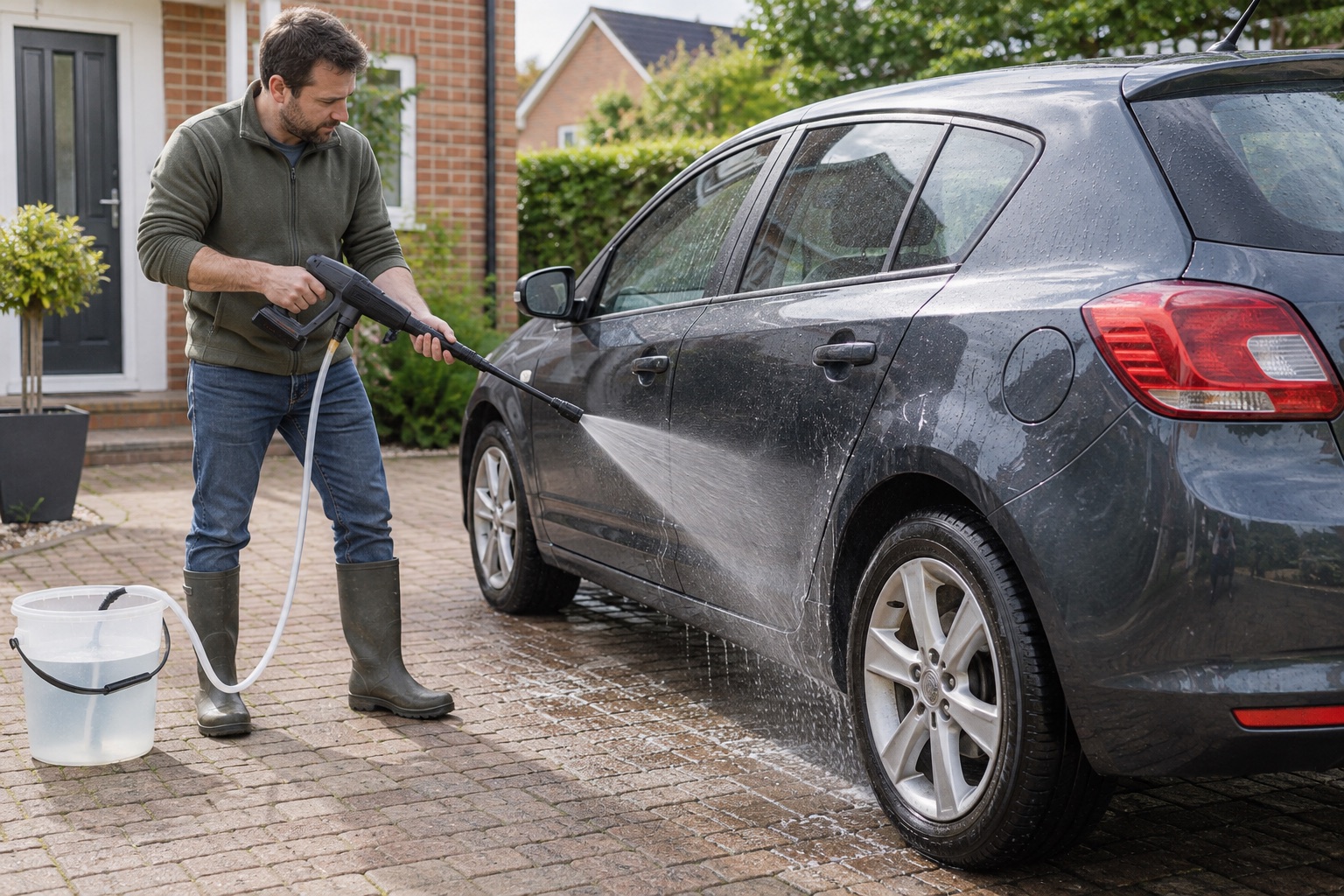
The Worx HydroShot is lighter and its six-metre suction hose separates the tool from the water container. It can work in shared parking where carrying a bucket is permitted. Its 220 l/h maximum flow is lower than a mains washer, so allow more time for the final rinse.
 View product on Amazon
Bosch Fontus 18V
Best for: Cars, bikes and furniture where a tap or socket is inconvenient
A wheeled cordless outdoor cleaner with a 15-litre built-in tank, adjustable output and four spray patterns. Its 20-bar pressure suits controlled rinsing rather than large-patio restoration.
What stands out
- 15-litre built-in water tank
- Four spray patterns
- Up to 60 minutes quoted with the recommended battery
Keep in mind
- The selected Amazon listing excludes battery and charger
- 20 bar is not intended for heavy paved-area cleaning
- 20 bar max
- 15 l tank
- 4 m hose
- 18 V battery
 View product on Amazon
Worx Nitro HydroShot WG633E
Best for: Bikes, garden furniture and quick rinses where portability matters most
A lightweight handheld cleaner rather than a substitute for a mains patio machine. It draws from a bucket or other fresh-water source and delivers 38-bar rated pressure with up to 220 l/h flow.
What stands out
- 2.2 kg with battery
- Draws from a separate water source
- Five spray patterns and 6 m suction hose
Keep in mind
- Far lower pressure and flow than a mains washer
- A poor fit for large or heavily soiled paving
- 38 bar rated
- 56 bar max
- 220 l/h max
- 20 V battery
Side by side
Compare cordless car-cleaning setups
| Model | Water source | Output | Reach | Best fit | Important check |
|---|---|---|---|---|---|
| Bosch Fontus 18V | Integrated 15 l tank | 20 bar max | 4 m hose | Self-contained driveway rinse | Tool-only listing excludes battery and charger |
| Worx Nitro HydroShot WG633E | Clean bucket or suitable source | 38 bar rated; up to 220 l/h | 6 m suction hose | Shared parking and compact storage | Keep filter submerged and bucket stable |
Use cordless pressure carefully around a car
- Read the vehicle and cleaner instructions, then inspect damaged paint and loose trim.
- Use the broadest suitable fan and begin from a generous distance.
- Work from upper panels down, keeping the jet moving.
- Avoid direct close-range spray at seals, cameras, sensors, charging ports and electrical components.
- Use a clean mitt and appropriate shampoo for contact cleaning; pressure alone does not safely remove bonded dirt.
- Rinse deliberately and dry with clean suitable towels.
Plan water by wash stage
A cordless system is most efficient when it handles the pre-rinse and final rinse while a separate bucket handles contact washing. Dry-brush heavy mud from arches only when safe, and avoid holding the trigger during pauses. A visibly measured container helps prevent running out halfway through the final rinse.
Never recycle dirty wash water through the cleaner. Grit can damage the pump and increase the risk of marking paint. Use the specified filter with a fresh clean source.
Frequently asked questions
Are cordless pressure washers safe for cars?
They can be when used with a broad fan, appropriate distance and careful avoidance of vulnerable components. Lower output is not permission to spray seals or damaged paint closely.
Is 20 bar enough to wash a car?
It can support pre-rinsing and final rinsing. A safe contact-wash stage is still needed for bonded road film.
How much water is needed for a cordless car wash?
It varies with vehicle size, dirt and trigger discipline. A 15-litre tank can support a controlled rinse but may need refilling for a larger or heavily soiled car.
Can I use a foam bottle with a cordless cleaner?
Only use a compatible manufacturer-approved attachment and suitable chemical. Foam does not replace contact washing or careful rinsing.
Which is better for a car: tank or bucket feed?
A tank is neater and self-contained; bucket feed is lighter and easier to scale. Choose according to the carrying route and space around the vehicle.