
Winter maintenance
How to store a pressure washer over winter
Shut down, drain and store a pressure washer and hoses frost-free without improvising antifreeze; restart safely after winter.
Finish the last wash properly
Choose a dry day to put the machine away. Follow the exact manual's shutdown, safe power-isolation and pressure-release sequence, with dry access to electrical connections. Keep the jet pointed safely throughout. Never unscrew a pressurised hose to speed up draining. Remove detergent according to the manufacturer's rinse instructions so residue does not dry in a dosing line.
Inspect the power cable and high-pressure hose as you pack up. Cracks, flattened sections, a damaged connector or leaks should be dealt with through the maker's service route before the next season, not hidden in storage. Wipe the body; do not hose water into vents or electrical controls.
Empty the water path without running the pump dry
Disconnect and drain the garden hose, gun, lance and nozzles as the manual describes. Some machines have a short motor-assisted emptying instruction, with a strict time limit; others use a different method. Copying a duration from another model risks dry-running your pump. Consult the exact model before doing any powered drain step.
Take out and clean only removable filter parts that the maker identifies as user-serviceable. Let them dry and refit or store as instructed so they cannot be lost. The Kärcher external filter below is an optional example to inspect for cracks and retained water if it is fitted; it is not something every washer needs to buy. Check the standard inlet screen as well. Coil hoses loosely, without tight bends or weights crushing them.
 View product on Amazon
Kärcher K-Series Water Filter
Best for: Filtering small particles from an approved water supply before a Kärcher K-series pump
A transparent inlet-side filter for the K 2–K 7 domestic range. It catches particles, but does not make dirty, chemically contaminated or unsuitable water safe for the washer.
An optional extra where the machine instructions and water source justify it; first inspect and clean any filter already built into the washer.
- Inlet side
- Part 4.730-059.0
- K 2–K 7
- Check existing filter
Choose a genuinely frost-free storage space
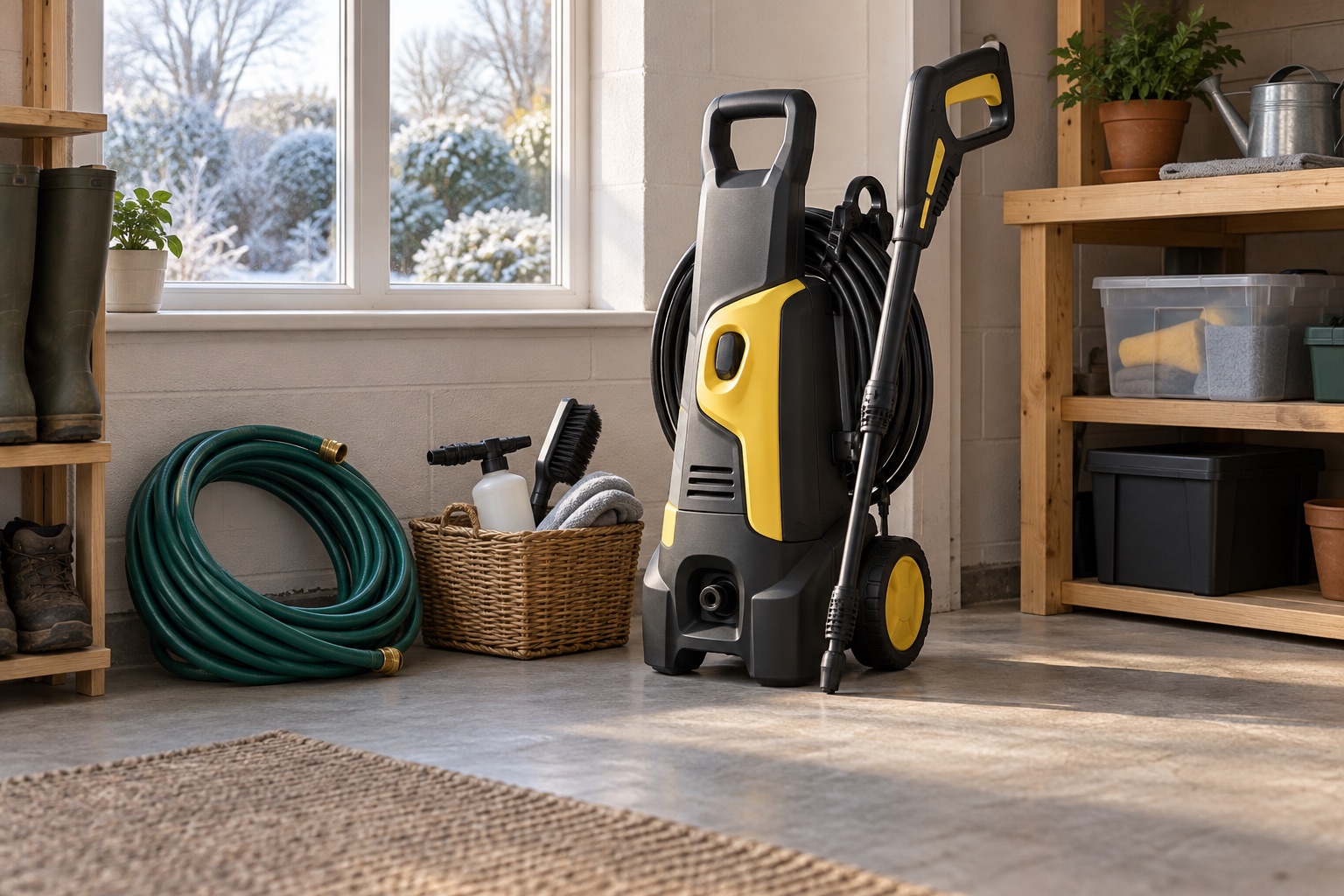
A heated utility room or demonstrably frost-free attached garage is safer than an unheated shed. A fabric cover may keep off dust but does not stop the pump freezing. Keep the machine upright where the maker requires, away from children, accidental impacts and standing water. Batteries from cordless cleaners have their own temperature and charging rules; store them by the battery manual, not inside a damp machine.
Do not pour car antifreeze, alcohol or unknown storage fluid through a pressure washer. Some manufacturers offer model-specific pump protectors; use one only if the exact instructions permit it. A safer universal principle is to drain by the manual and avoid freezing conditions altogether.
Check before the first spring run
Inspect hoses, seals, plug and filter for winter damage. Reconnect to a clean adequate water source, prime or vent as directed and watch from a safe distance for leaks. Never start a machine that may still be frozen. If it leaks from the housing, fails to build pressure or trips protection, switch off and use the appropriate leak or no-start guide before arranging service.
Take the plan outside
Pressure-washer winter storage checklist
Use your exact washer and battery manuals. This reminder does not supply a universal shutdown order, powered drain duration or storage temperature.
Tick on screen or leave blank to tick on paper. Nothing is saved or submitted. Printing includes this checklist only.
Exact model / material / product:
Notes / conditions:
Care references: Kärcher UK-linked Flex manual: storage and frost protection; Electrical Safety First: pressure-washer safety. Checked September 2026. Your exact manual, material guidance and current label take priority.
Frequently asked questions
Can I leave a pressure washer in an unheated shed?
Only if it is reliably frost-free and the model manual permits it. A cover alone cannot protect trapped water from freezing.
Should I run the pump dry before storing it?
Only perform the exact drain step and time limit in your manual. Prolonged dry running can damage the pump.
Can I put antifreeze in a pressure washer?
Do not improvise. Use only a manufacturer-approved product and method for the exact model, if one is specified.
What should I do with the high-pressure hose?
Drain it as directed and coil it loosely without kinks, sharp bends or crushing loads.
What if the machine was frozen over winter?
Do not switch it on. Let it thaw fully in a frost-free place, inspect for leaks or cracks and seek service if damage is suspected.