
Driveway buying guide
Best pressure washers for driveways
The best pressure washers for UK driveways, compared by flow, hose reach, control and suitability for block paving, concrete, tarmac and resin-bound surfaces.
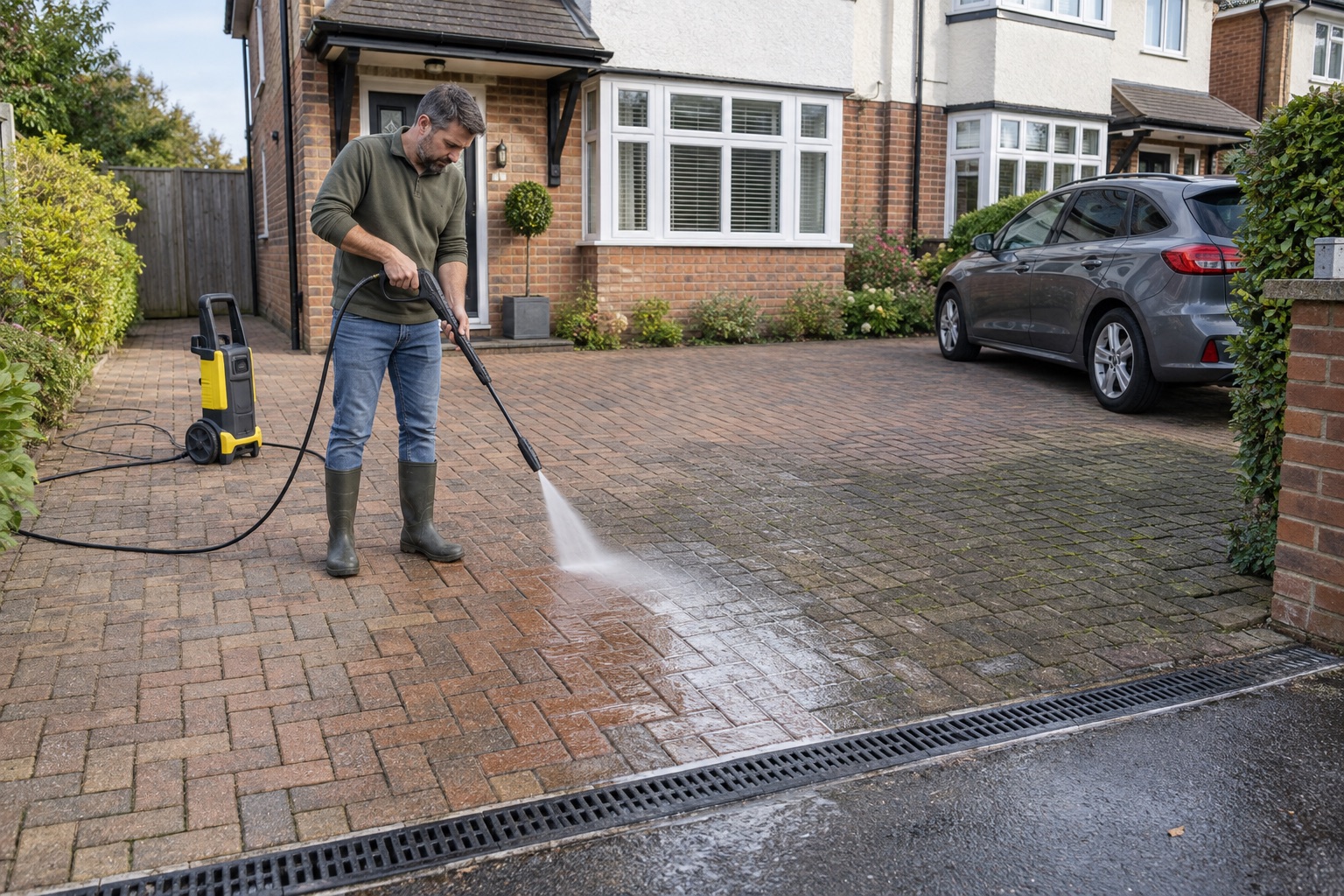
Kärcher specifies an eight-metre high-pressure hose and a maximum flow of 420 litres per hour for the K 4 Power Control Flex, useful figures when planning broad-area reach. Check Kärcher's specifications.
Start with the area
A driveway asks more of flow, hose and setup
Driveways expose the difference between headline pressure and sustained cleaning. A narrow jet can shift one mark, but clearing a broad paved area depends on water flow, a sensible working width and enough hose to reach without repeatedly dragging the machine.
The Nilfisk Core 140 leads this selection for robust medium areas because its 465 l/h maximum flow and power control support steady work. The Kärcher K 4 is the more rounded domestic buy, with an eight-metre flexible hose and a wider adjustment range for moving between paving and gentler jobs.
 View product on Amazon
Nilfisk Core 140 PowerControl
Best for: Users who value in-hand adjustment and a lighter trolley format
A light trolley-format washer with power adjustment for mixed-garden jobs. The current Amazon page conflicts on supplied hose length, so confirm the exact bundle before buying it for reach.
What stands out
- Power adjustment
- Compact trolley format
- Useful mid-range output
Keep in mind
- Bundles differ between retailers
- A surface cleaner may still be an extra purchase
- 140 bar max
- 40 m²/h listed
- Confirm hose length
- Mains · 1.8 kW
 View product on Amazon
Kärcher K 4 Power Control Flex
Best for: Mixed household cleaning where control and an 8 m flexible hose matter
A balanced mains machine for patios, cars and general outdoor work. Its useful advantage is not extreme pressure but adjustable output, a flexible 8 m hose and a stable mid-range flow rate.
What stands out
- 20–130 bar adjustment
- 8 m PremiumFlex hose
- 420 l/h maximum flow
Keep in mind
- The base package does not include a surface cleaner
- At 12.1 kg before accessories it is not the lightest option
- 20–130 bar
- 420 l/h
- 8 m hose
- Mains · 1.8 kW
Compact alternatives for shorter drives
The Bosch UniversalAquatak 135 offers strong listed flow in a lighter, simpler package. Its seven-metre hose is workable for a single-car drive, although the machine may need repositioning. The AVA Go P40 gives back some rinsing speed in return for a compact body and eight-metre flexible hose.
 View product on Amazon
Bosch UniversalAquatak 135
Best for: Smaller homes wanting one compact machine with a multi-pattern nozzle
A compact 135-bar washer with a strong 450 l/h maximum flow and a practical three-in-one nozzle. It reduces attachment swapping for routine car, furniture and small-patio jobs.
What stands out
- 450 l/h maximum flow
- Three spray patterns in one nozzle
- 7.9 kg machine weight
Keep in mind
- No surface cleaner in the standard box
- The 7 m PVC hose is shorter and less flexible than some rivals
- 135 bar max
- 450 l/h
- 7 m hose
- Mains · 1.9 kW
 View product on Amazon
AVA Go P40 Medium
Best for: Cars, bikes and smaller outdoor areas where storage space is tight
A genuinely compact 120-bar mains washer with an 8 m flexible hose and 390 l/h flow. The small body and stored accessories make it appealing for sheds, garages and mobile car-care setups.
What stands out
- Compact body with stored accessories
- 8 m flexible hose
- Ten-year warranty when registered under AVA's terms
Keep in mind
- No surface cleaner in the Medium bundle
- Lower flow than the mid-range corded leaders here
- 120 bar max
- 390 l/h
- 8 m hose
- Mains · 1.7 kW
Side by side
Driveway-cleaning specifications
| Model | Pressure | Flow | Hose | Best fit | Main limitation |
|---|---|---|---|---|---|
| Nilfisk Core 140 PowerControl | 140 bar max | 465 l/h max | Confirm bundle hose | Medium robust paved areas | Hose length unresolved |
| Kärcher K 4 Power Control Flex | 20–130 bar | 420 l/h | 8 m | Mixed driveway and garden jobs | Base package has no surface head |
| Bosch UniversalAquatak 135 | 135 bar max | 450 l/h | 7 m | Compact driveway all-rounder | No reel or surface head |
| AVA Go P40 Medium | 120 bar max | 390 l/h | 8 m | Small drives and easy storage | Slower broad-area rinsing |
The driveway material changes the recommendation
Block paving
Sound block paving can suit controlled pressure washing, but the jet will often remove jointing sand. Avoid digging into the joints, plan a consistent cleaning pattern and allow sufficient drying before re-sanding. A surface head reduces splash but does not prevent sand loss.
Concrete
Sound, mature concrete tolerates more than many coated or bound surfaces, yet cracks, weak repairs and spalled areas remain vulnerable. Start with a broad fan and treat heavy local staining separately instead of attacking the whole slab with maximum pressure.
Tarmac and asphalt
Close pressure can lift aggregate and scar aged or softened surfaces. Many tarmac drives are better served by sweeping, a suitable cleaner and a gentle rinse. If the surface is loose, cracked or recently repaired, do not use a pressure washer.
Resin-bound and resin-bonded systems
These are not interchangeable. Follow the installer or system maker's maintenance guidance, use low pressure where permitted and keep a generous distance. Unknown, damaged or delaminating finishes should be assessed before cleaning.
Measure the working route, not the product box
Measure from the outdoor tap and protected socket to the furthest point, then account for cars, gates and corners. A hose that only reaches in a straight line will rub bodywork or pull the machine over when the path changes. Our guide to pressure washers with longer hoses covers this in detail.
For large paved areas, flow becomes more important because every pass creates dirty water that must be moved. A surface cleaner can provide a broader, more consistent pattern on flat, suitable paving. Match its width and connector to the machine rather than buying a generic head by appearance.
Plan runoff before starting
Identify whether the nearest drain carries surface water or foul water. Muddy water containing oil, fuel, brake dust, detergent or treatment residue must not be allowed to run into a surface-water drain. Sweep and absorb oily patches before washing, follow product labels and contain contaminated residue for appropriate disposal.
Move vehicles, protect low vents and garage doors, keep pedestrians away and work from the high point towards a controlled collection area. RCD protection, inspected cables, eye protection and stable footwear remain essential.
When a larger machine is worth it
Paying for additional flow, reach and a well-matched surface head makes sense when the driveway is broad, the material is robust and cleaning is regular. It is poor value when the surface itself limits pressure. For a small single-car drive, a manageable mid-range machine often gives a better ownership experience than a heavy high-output unit.
Compare the broader shortlist in best pressure washers for UK homes before assuming a driveway-specific purchase is necessary.
Frequently asked questions
What is the best pressure washer for block paving?
A controllable mains washer with useful flow and a compatible surface head is a sensible fit, provided the blocks are stable and you plan to replace displaced jointing sand after drying.
How much flow is useful for a driveway?
There is no single threshold, but a mid-range machine around 420–465 l/h will generally rinse a broad area more efficiently than a small low-flow washer. Surface condition still determines safe pressure.
Can I pressure wash a tarmac drive?
Only if the surface maker or installer permits it and the tarmac is sound. Use low pressure, a broad fan and generous distance. Do not pressure wash loose, cracked or soft areas.
Does block paving need re-sanding after pressure washing?
Usually, if the cleaning has removed jointing sand. Let the paving and joints dry sufficiently and use the sand specified for the paving system.
Is a surface cleaner better than a lance for driveways?
It is often faster and tidier on flat robust paving. A lance remains useful for edges and local work. Neither makes fragile joints, resin or damaged tarmac safe.