
Wash-brush buying guide
Pressure-washer brush attachments explained
Choose a compatible pressure-washer wash brush, understand when soft bristles still scratch, and compare brush use with a fan jet.
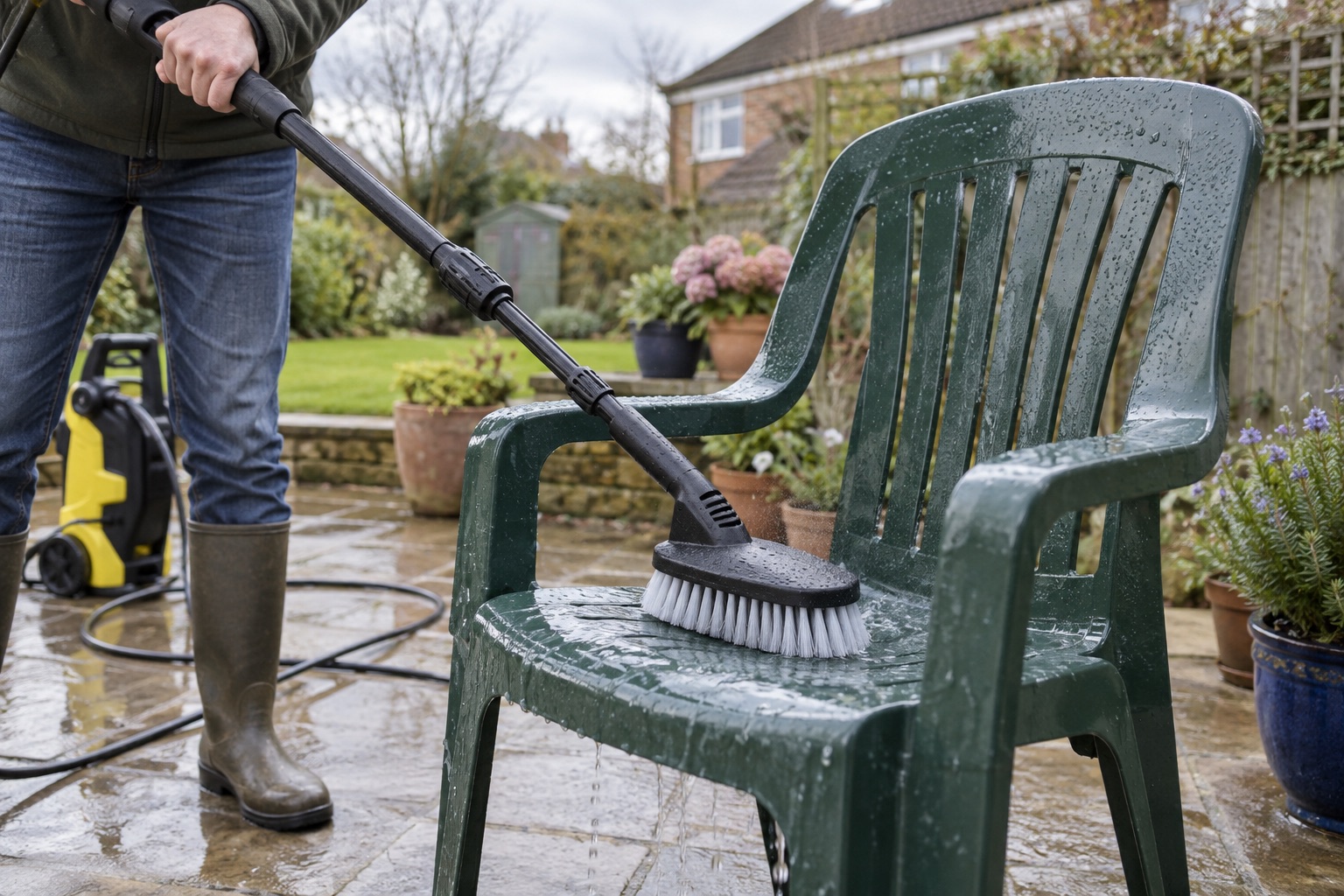
Kärcher describes the WB 60 as a soft-surface brush for larger areas including vehicles and conservatories; this does not override the care instructions for a particular finish. See Kärcher's brush details.
Fixed soft brush, rotary brush or no brush?
A fixed soft wash brush combines water delivery with gentle contact. It is useful when a rinse alone leaves a thin film on a robust, maker-approved surface. A powered rotary brush adds mechanical movement; that can speed cleaning but also concentrates abrasion if grit is trapped. A hand-held microfibre mitt or separate soft brush may be easier to inspect and rinse between passes.
The Kärcher WB 60, part 2.643-233.0, has a roughly 248 mm working width and is listed for K 2–K 7 domestic machines. It is a genuine accessory for that family, not a promise that it fits Bosch, Nilfisk or AVA. Check gun generation and the exact package if your machine is older.
 View product on Amazon
Kärcher WB 60 Soft Washing Brush
Best for: Gentle contact cleaning on suitable cars, furniture and large washable surfaces
A roughly 248 mm wide soft-bristle brush for K-series pressure washers. Rinse grit from both the brush and surface before contact to avoid dragging particles across delicate finishes.
Appropriate only where the surface maker allows contact brushing; never assume soft bristles cannot scratch.
- 248 mm width
- Part 2.643-233.0
- K 2–K 7
- Pre-rinse first
Match contact to the material
On a car, rinse loose grit before brush contact and use car-safe shampoo. Do not rub a dirty brush across paint, plastic lenses or a damaged coating. For plastic furniture, test a hidden area and follow the furniture maker's cleaner guidance. Painted metal can chip if the brush edge or trapped grit catches a weak finish. Solar panels and glazing demand their own maker's method; a soft-bristle label alone is not approval.
Timber and composite decking need board-specific bristle and detergent advice. A brush that is suitable for a car may still catch a raised grain or scratch a composite cap. Our composite-decking guide explains why a board-safe manual brush can be preferable.
Clean with contact, not pressure
- Check that the brush and washer are explicitly compatible.
- Pre-rinse both surface and bristles; remove visible sand or grit.
- Apply suitable detergent, observing its dwell instructions without letting it dry.
- Use light, straight passes and rinse the brush frequently.
- Rinse the surface and inspect in good light before repeating.
Stop if you see scuffing or lifted finish. Never press harder to compensate for poor chemistry or a dirty brush. The nozzle guide explains when a broad fan is preferable for pre-rinsing.
Frequently asked questions
Can a soft brush scratch car paint?
Yes, particularly if grit is trapped in the bristles or the coating is already damaged. Pre-rinse and inspect first.
Will the WB 60 fit a Nilfisk pressure washer?
No direct fit should be assumed; Kärcher lists it for its K-series machines.
Is a rotary brush better than a fixed brush?
It may reduce manual effort on approved robust surfaces, but it adds abrasion risk on delicate finishes.
Can I use a brush on composite decking?
Only if its bristles and detergent match the board maker's guidance; test an inconspicuous board.
Do I need a pressure-washer brush for furniture?
Often not. A suitable manual brush and cleaner may be simpler and gentler.