
Complete buying guide
How to choose a pressure washer for your home and garden
Choose the right pressure washer by surface, area, water source, hose reach and control instead of relying on maximum bar alone.
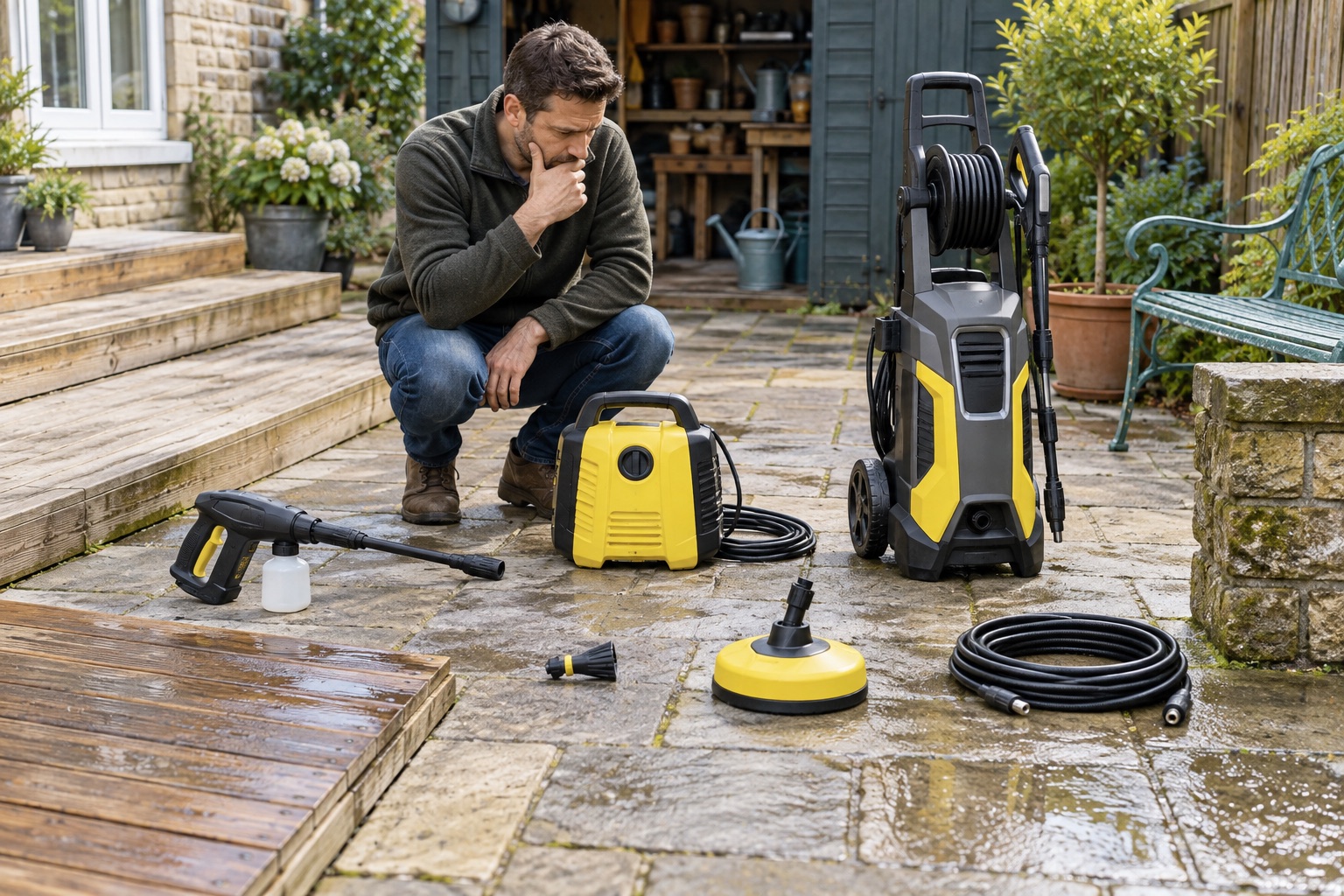
The decision in five steps
Begin with the surface, not the biggest pressure number
- List regular jobs: separate weekly car or bike rinsing from annual patio cleaning.
- Identify materials and condition: sound concrete, soft stone, timber, render and vehicle paint have different limits.
- Measure the working route: include tap, protected socket, corners, steps and the furthest cleaning point.
- Choose a format: mains for sustained output, tank-fed for self-contained access or handheld for portable rinsing.
- Check the exact bundle: hose, battery, charger, surface head, nozzles and adapters can change the real value.
This order prevents the common mistake of buying maximum pressure first and discovering later that the hose is short, the nozzle is unsuitable or the machine cannot draw from the intended water source.
Choose your route
Match the material, job and available supply
A sound-looking surface is not permission to pressure wash it. This selector keeps damage and unknown care limits ahead of equipment choices; a brush-and-rinse method can be the right answer even when a tap and socket are available.
Material first, equipment second
Concrete paving
- Starting method
- Brush first; sweep, brush and rinse; pressure washing only if the paving care permits
- Pressure or distance
- No universal pressure or distance setting: follow the exact surface and machine instructions.
- First move
- Confirm the maker's care limits before a jet, cleaner or finishing treatment.
A suitable water or power supply does not make pressure washing safe for a material.
Read the material guide →Why the same supply can lead to different methods
Marshalls' sandstone guidance starts with simple manual cleaning and warns against acidic cleaners. Trex's care guidance varies by composite range, while K Rend's maintenance guidance is specific to its render systems. None is a general approval for a similar-looking material from another maker.
A container is a supply constraint, not proof of self-priming. Check the exact manual and required suction equipment in the no-outside-tap guide. Measure usable water with the water calculator and plan protected electricity with the electrical setup guide.
Three formats cover most domestic needs
Mains pressure washers
These deliver the continuous flow and pressure needed for patios, paths and driveways. A mid-range adjustable model is the versatile default for a home with several surfaces.
 View product on Amazon
Kärcher K 4 Power Control Flex
Best for: Mixed household cleaning where control and an 8 m flexible hose matter
A balanced mains machine for patios, cars and general outdoor work. Its useful advantage is not extreme pressure but adjustable output, a flexible 8 m hose and a stable mid-range flow rate.
What stands out
- 20–130 bar adjustment
- 8 m PremiumFlex hose
- 420 l/h maximum flow
Keep in mind
- The base package does not include a surface cleaner
- At 12.1 kg before accessories it is not the lightest option
- 20–130 bar
- 420 l/h
- 8 m hose
- Mains · 1.8 kW
 View product on Amazon
Bosch UniversalAquatak 135
Best for: Smaller homes wanting one compact machine with a multi-pattern nozzle
A compact 135-bar washer with a strong 450 l/h maximum flow and a practical three-in-one nozzle. It reduces attachment swapping for routine car, furniture and small-patio jobs.
What stands out
- 450 l/h maximum flow
- Three spray patterns in one nozzle
- 7.9 kg machine weight
Keep in mind
- No surface cleaner in the standard box
- The 7 m PVC hose is shorter and less flexible than some rivals
- 135 bar max
- 450 l/h
- 7 m hose
- Mains · 1.9 kW
Compact and adjustable mains machines
The Nilfisk prioritises adjustment and flow in a small trolley, while the AVA prioritises storage and a flexible eight-metre hose. Both illustrate why format and handling can matter more than ten or twenty extra bar.
 View product on Amazon
Nilfisk Core 140 PowerControl
Best for: Users who value in-hand adjustment and a lighter trolley format
A light trolley-format washer with power adjustment for mixed-garden jobs. The current Amazon page conflicts on supplied hose length, so confirm the exact bundle before buying it for reach.
What stands out
- Power adjustment
- Compact trolley format
- Useful mid-range output
Keep in mind
- Bundles differ between retailers
- A surface cleaner may still be an extra purchase
- 140 bar max
- 40 m²/h listed
- Confirm hose length
- Mains · 1.8 kW
 View product on Amazon
AVA Go P40 Medium
Best for: Cars, bikes and smaller outdoor areas where storage space is tight
A genuinely compact 120-bar mains washer with an 8 m flexible hose and 390 l/h flow. The small body and stored accessories make it appealing for sheds, garages and mobile car-care setups.
What stands out
- Compact body with stored accessories
- 8 m flexible hose
- Ten-year warranty when registered under AVA's terms
Keep in mind
- No surface cleaner in the Medium bundle
- Lower flow than the mid-range corded leaders here
- 120 bar max
- 390 l/h
- 8 m hose
- Mains · 1.7 kW
Tank-fed and handheld cordless cleaners
The Bosch Fontus takes its own water; the Worx draws from a separate clean source. They solve access problems and suit controlled rinsing, but lower flow and limited runtime make them poor substitutes for a mains patio washer.
 View product on Amazon
Bosch Fontus 18V
Best for: Cars, bikes and furniture where a tap or socket is inconvenient
A wheeled cordless outdoor cleaner with a 15-litre built-in tank, adjustable output and four spray patterns. Its 20-bar pressure suits controlled rinsing rather than large-patio restoration.
What stands out
- 15-litre built-in water tank
- Four spray patterns
- Up to 60 minutes quoted with the recommended battery
Keep in mind
- The selected Amazon listing excludes battery and charger
- 20 bar is not intended for heavy paved-area cleaning
- 20 bar max
- 15 l tank
- 4 m hose
- 18 V battery
 View product on Amazon
Worx Nitro HydroShot WG633E
Best for: Bikes, garden furniture and quick rinses where portability matters most
A lightweight handheld cleaner rather than a substitute for a mains patio machine. It draws from a bucket or other fresh-water source and delivers 38-bar rated pressure with up to 220 l/h flow.
What stands out
- 2.2 kg with battery
- Draws from a separate water source
- Five spray patterns and 6 m suction hose
Keep in mind
- Far lower pressure and flow than a mains washer
- A poor fit for large or heavily soiled paving
- 38 bar rated
- 56 bar max
- 220 l/h max
- 20 V battery
Useful examples
Match the setup to the household
Small terrace with a car and courtyard
Choose a compact mains machine with a flexible seven-to-eight-metre hose. Prioritise a broad fan and storage. If there is no outside tap, a tank-fed cleaner may be more useful than greater pressure.
Family home with patio, car and furniture
An adjustable mid-range mains washer around 120–140 bar and 400–465 l/h provides the broadest fit. Add a surface head only if the paving is suitable and the exact connector matches.
Large block-paved driveway
Flow, hose reach and a matched surface head become more important. Plan drainage and re-sanding before cleaning. If the surface is resin, tarmac or damaged, identify its limits before choosing any pressure washer.
Bike, muddy kit and travel cleaning
A handheld cordless cleaner can be the better tool. Its reduced output is a feature around bearings and delicate components, provided the jet still stays away from vulnerable areas.
Side by side
Formats and realistic roles
| Model | Format | Pressure | Flow / water | Hose | Best starting use |
|---|---|---|---|---|---|
| Kärcher K 4 Power Control Flex | Adjustable mains trolley | 20–130 bar | 420 l/h | 8 m | Mixed home and garden |
| Bosch UniversalAquatak 135 | Compact mains | 135 bar max | 450 l/h | 7 m | Storage-conscious all-round use |
| Nilfisk Core 140 PowerControl | Adjustable mains trolley | 140 bar max | 465 l/h max | Confirm bundle hose | Deliberate pressure changes |
| AVA Go P40 Medium | Compact mains | 120 bar max | 390 l/h | 8 m | Cars and smaller areas |
| Bosch Fontus 18V | Tank cordless cleaner | 20 bar max | 15 l tank | 4 m | Cleaning without a nearby tap |
| Worx Nitro HydroShot WG633E | Handheld cordless cleaner | 38 bar rated | 220 l/h max | 6 m suction | Portable rinsing |
How to read the specifications
Pressure loosens dirt
Bar or PSI describes water pressure. Maximum figures are not the setting to use everywhere. Nozzle geometry and working distance can make the same machine gentle or destructive.
Flow moves dirt away
Litres per hour describe water delivery. Higher flow improves broad-area rinsing and can help a surface-cleaner head work efficiently. It also increases water use, so the goal is enough flow for the area rather than the highest available.
Hose length controls movement
Measure the route rather than the straight-line distance. Seven metres is workable for many small jobs; eight metres gives more freedom around a car and furniture. Flexibility and reel design affect the usable length.
Motor power is not a surface recommendation
Watts describe electrical input, not whether the jet is safe for sandstone, paint or decking. Use the surface and machine instructions together.
Buy attachments for named jobs
- Variable fan lance: the everyday choice for controlled work.
- Rotary or turbo nozzle: local use on robust permitted surfaces, never the universal default.
- Surface cleaner: even passes and less splash on suitable flat paving.
- Foam lance: vehicle pre-wash when the cleaner and connector are compatible.
- Suction hose and filter: only where the machine is designed to draw from an alternative clean-water source.
Bundle suffixes can describe accessories rather than a different pump. Compare exact Amazon titles and part numbers. If hose reach is the main problem, see our long-hose guide; for paving, compare surface-cleaner setups.
Use the exact-bundle comparison to distinguish a base package, a battery kit and a bare tool before adding accessories to the cost.
Safety and ownership belong in the purchase
Choose a machine you can move with a stable stance, connect to a protected supply and store frost-free. Outdoor electrical equipment should use appropriate RCD protection, with cables and connections inspected and kept away from spray. Eye protection and stable footwear are basic requirements.
Never point the jet at people or animals, use a hand to locate a leak or operate the lance from a ladder. Identify drains before using detergents, and keep contaminated wash water away from surface-water systems.
Frequently asked questions
What pressure washer should I buy for general home use?
A controllable mains machine around 120–140 bar, 390–465 l/h and seven-to-eight metres of hose is the practical middle ground for many UK homes.
Is more bar always better?
No. Excess pressure can damage joints, timber, coatings and vehicle components. Flow, nozzle, distance and adjustment are equally important.
Do I need a surface-cleaner attachment?
It is useful for a sizeable area of flat robust paving. It is unnecessary for cars, furniture and small detail work, and it does not make fragile paving safe.
Should I buy cordless or mains?
Choose mains for sustained patio and driveway work. Choose cordless when access to water or electricity is the limiting problem and the jobs are lighter.
Can a pressure washer draw water from a bucket?
Only models designed for self-priming or supplied with a suitable suction system. Use the specified filter and follow minimum-depth and priming instructions.
How long should a pressure washer last?
That depends on design, use, storage and maintenance. Correct water supply, clean filters, pressure relief, frost protection and compatible accessories all help avoid premature failure.