
Water-use explainer
Pressure-washer water use explained
Calculate pressure-washer water use from flow and trigger time, compare sourced worked examples, and estimate water-butt runtime without running dry.
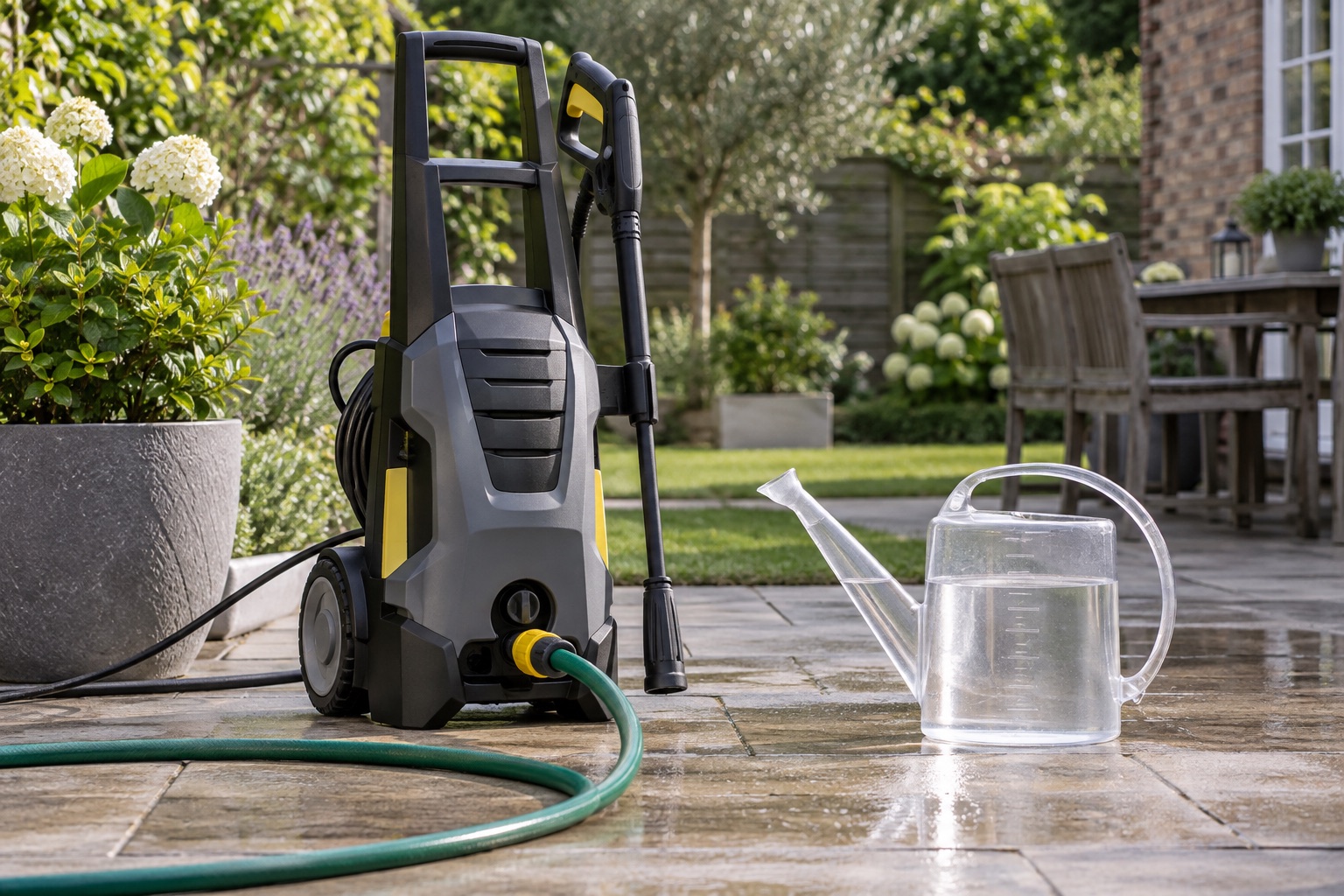
How to calculate pressure-washer water use
Find the machine's maximum flow in litres per hour (l/h), divide by 60, then multiply by minutes of actual trigger time. Do not substitute the full length of the cleaning session: brushing, moving furniture and applying detergent can take longer than spraying. For example, 420 l/h ÷ 60 = 7 l/min. Ten minutes of continuous output at that maximum would be 70 litres.
This is a planning estimate, not a water-meter reading. A pressure washer may flow below its rated maximum depending on nozzle and mode. If you need an accurate figure for a water butt, mark the container level before and after a short controlled session rather than relying on a brochure number. Never intentionally starve the pump to save water.
Calculate water use for your own spraying time
Plan your water supply
Water-use calculator
Enter the flow from your washer's specification and the minutes you expect to hold the trigger. This calculates water at that constant flow, not the length of the whole cleaning session.
Example: 420 l/h for 15 minutes
- Flow per minute
- 7 litres/minute
- Calculated water use
- 105 litres
- Theoretical water-only runtime
- No water budget entered
420 ÷ 60 × 15 = 105 litres
Enter usable litres to calculate a theoretical water-only runtime.
Displayed values are rounded. A maximum flow rating gives a planning estimate, not guaranteed consumption. Settings and supply affect actual flow. Never reduce the inlet supply to save water, and do not use this result to approve an unsupported water-butt setup.
If a half-hour job contains ten minutes of spraying and twenty minutes of moving furniture, brushing and pausing, enter 10 minutes. At 420 l/h, that calculation is 70 litres, not the 210 litres that thirty uninterrupted trigger-on minutes would require. This example explains the arithmetic; it does not predict how long your patio will take.
Worked water-use comparison: five to twenty minutes
The table converts the two manufacturers' maximum flow figures into water volumes at four trigger-on durations. These are calculated scenarios at constant maximum flow, not consumption promises. Specifications checked in September 2026; confirm the exact model code before using a row for your machine.
| Model and source | Maximum flow | 5 trigger-on minutes | 10 trigger-on minutes | 15 trigger-on minutes | 20 trigger-on minutes |
|---|---|---|---|---|---|
| Kärcher K 4 Power Control Flex1.324-302.0Kärcher specification | 420 l/h7 l/min | 35 litres | 70 litres | 105 litres | 140 litres |
| Bosch UniversalAquatak 13506008A7C70Bosch specification | 450 l/h7.5 l/min | 37.5 litres | 75 litres | 112.5 litres | 150 litres |
What matters more: flow or time?
For fifteen trigger-on minutes, the difference between these maximum-flow figures is 7.5 litres. Holding the trigger for five extra minutes at 420 l/h adds 35 litres. That is a useful reason to plan the work and release the trigger while moving obstacles—not proof that one washer cleans more efficiently.
Compare pressure washers by the whole job: pressure control, flow, nozzle, hose reach and surface compatibility. A lower-flow handheld cleaner can be sensible for a bicycle, but a large paved area may take longer and require more repeated passes. Maximum bar alone tells you little about total water use.
 View product on Amazon
Kärcher K 4 Power Control Flex
Best for: Mixed household cleaning where control and an 8 m flexible hose matter
A balanced mains machine for patios, cars and general outdoor work. Its useful advantage is not extreme pressure but adjustable output, a flexible 8 m hose and a stable mid-range flow rate.
What stands out
- 20–130 bar adjustment
- 8 m PremiumFlex hose
- 420 l/h maximum flow
Keep in mind
- The base package does not include a surface cleaner
- At 12.1 kg before accessories it is not the lightest option
- 20–130 bar
- 420 l/h
- 8 m hose
- Mains · 1.8 kW
 View product on Amazon
Bosch UniversalAquatak 135
Best for: Smaller homes wanting one compact machine with a multi-pattern nozzle
A compact 135-bar washer with a strong 450 l/h maximum flow and a practical three-in-one nozzle. It reduces attachment swapping for routine car, furniture and small-patio jobs.
What stands out
- 450 l/h maximum flow
- Three spray patterns in one nozzle
- 7.9 kg machine weight
Keep in mind
- No surface cleaner in the standard box
- The 7 m PVC hose is shorter and less flexible than some rivals
- 135 bar max
- 450 l/h
- 7 m hose
- Mains · 1.9 kW
Save water without underfeeding the machine
Remove loose grit with a broom before wetting paving. Work in manageable sections and release the trigger while moving obstacles. Use the lowest effective setting and a suitable fan pattern rather than repeatedly blasting the same area. A compatible surface cleaner can sometimes make broad, sound paving more consistent; it is not suitable for every joint or finish. For delicate surfaces, a brush and controlled rinse may be the better method altogether.
Detergent is not automatically a water-saving shortcut. Some treatments require pre-wetting and thorough rinsing, and the runoff may need containment. Our runoff guide explains why dirty washwater should not simply be directed to a road gully.
Make sure the supply keeps up
A garden tap or approved static-water setup must deliver enough clean water for the exact washer. A kinked hose, partially closed tap or blocked inlet screen may reduce flow even when the source holds plenty of water. If output pulses or weakens, stop and check the pulsing causes; do not let the pump run dry.
For a water butt, usable volume is less than its nominal capacity because the strainer must remain submerged above settled debris. A 100-litre usable supply divided by 7.5 l/min is only about 13 minutes at that maximum flow. Refill before the level falls too low, and use a supported self-priming kit where the manual requires one. See the water-butt setup guide.
Frequently asked questions
How many litres does a pressure washer use in 10 minutes?
Multiply its rated litres per minute by ten for an upper planning estimate. A 420 l/h machine works out to about 70 litres at maximum flow.
Does a higher bar rating mean more water use?
Not necessarily. Bar describes pressure; litres per hour describe flow. Compare both and consider trigger time.
Does turning the pressure down always save water?
No. Flow and pressure do not move in a simple, universal proportion, and a gentler pass may take longer. Check the model's specification or measure use.
Can I run a washer from a small water butt?
Only if the exact model permits that source and the clean water volume, suction arrangement and flow remain adequate. Stop before the strainer becomes exposed.
Does a pressure washer use less water than a garden hose?
It can, but there is no universal saving. The hose flow, washer setting, nozzle and time spent rinsing determine the comparison.