
Alternative-water setup
How to use a pressure washer with a water butt
Check self-priming support, clean rainwater, suction height, strainer position and water volume before running a pressure washer from a water butt.
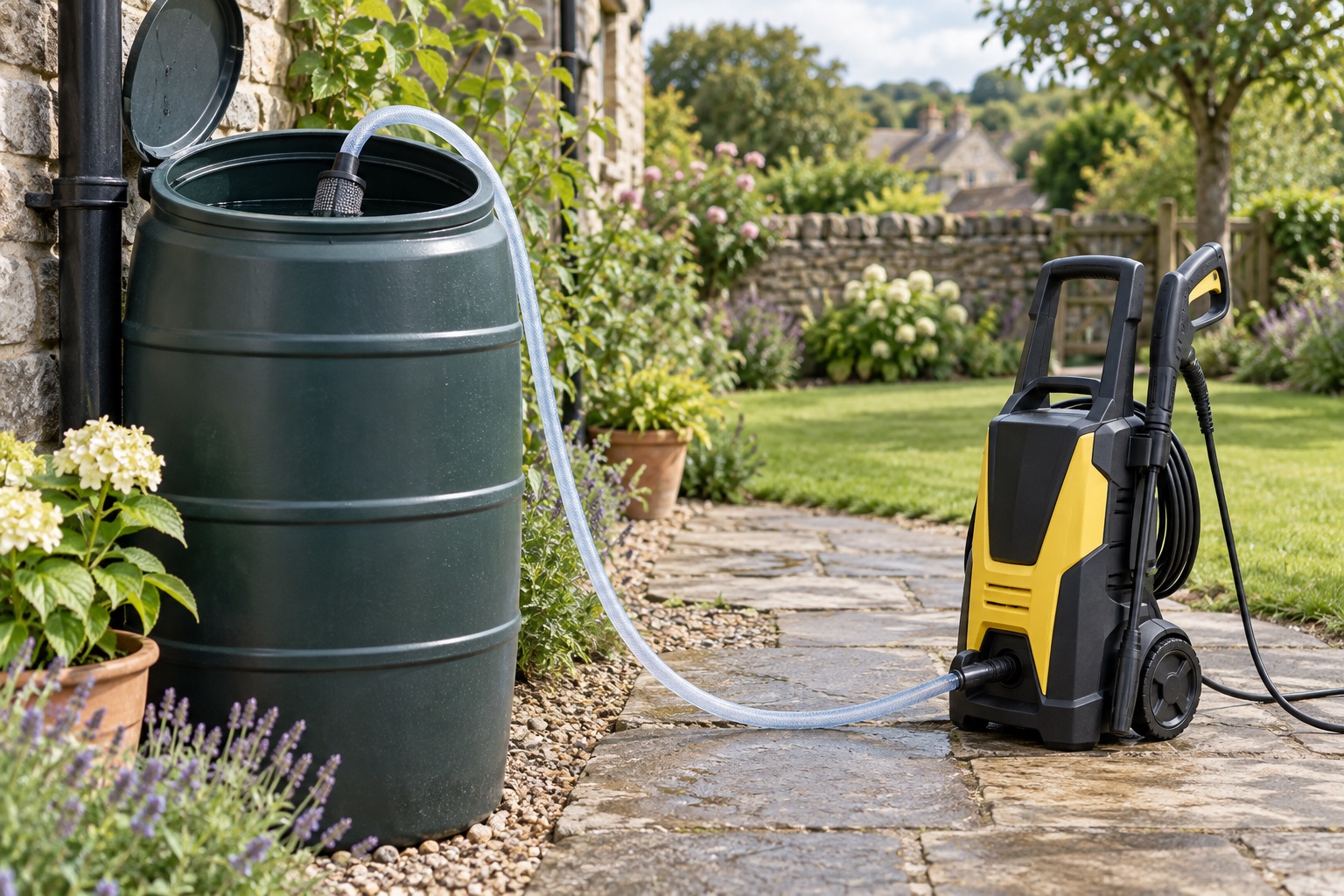
Bosch describes its Self Priming Kit as a three-metre supply hose with a strainer and non-return valve for suitable Aquatak washers using alternative water sources. See Bosch's kit specification.
First check whether your machine can use stored water
Some washers are designed to self-prime from an open container; others need a gravity-fed tank outlet, and some require mains-pressure tap water. These arrangements are not interchangeable. Find the exact model and serial version in the manual, then check permitted water source, maximum suction lift, inlet hose, filter, backflow precautions and priming sequence. If the manual is silent, ask the manufacturer before connecting a butt.
For a concrete example, Bosch's UniversalAquatak 135 manual describes drawing clean water from a tank with its self-priming accessory kit and specifies a 0.5 m maximum lift above the water level for that setup. Bosch's kit F016800421 includes a three-metre reinforced supply hose, strainer with non-return valve and coupling. That 0.5 m figure is not a limit to apply to every washer. The Bosch pair below is included to show an expressly documented combination, not because its connectors resemble other brands.
 View product on Amazon
Bosch Self Priming Kit
Best for: Feeding a compatible Bosch Aquatak washer from a clean water butt or tank
Bosch's three-metre inlet hose includes a strainer and non-return valve for supported Aquatak alternative-water setups. It must be primed and used within the exact washer manual's lift and water-quality limits.
Use only with the specified Bosch Aquatak range and a clean source; this is an inlet kit, not a high-pressure hose or a cure for pump faults.
- Part F016800421
- 3 m inlet hose
- Strainer and valve
- Aquatak range
 View product on Amazon
Bosch UniversalAquatak 135
Best for: Smaller homes wanting one compact machine with a multi-pattern nozzle
A compact 135-bar washer with a strong 450 l/h maximum flow and a practical three-in-one nozzle. It reduces attachment swapping for routine car, furniture and small-patio jobs.
What stands out
- 450 l/h maximum flow
- Three spray patterns in one nozzle
- 7.9 kg machine weight
Keep in mind
- No surface cleaner in the standard box
- The 7 m PVC hose is shorter and less flexible than some rivals
- 135 bar max
- 450 l/h
- 7 m hose
- Mains · 1.9 kW
Set up the approved inlet without drawing air
- Place the washer level and stable, with plug and socket away from the water butt, runoff and spray.
- Use a clean butt and the exact maker-approved inlet kit or a permitted outlet hose arrangement.
- Keep the strainer below the water surface but above settled silt; make every coupling airtight.
- Fill or prime the suction hose according to the manual, then vent the washer by its stated procedure before attaching or using the lance.
- Check for steady water flow and stop promptly if priming fails; never keep the pump running dry.
Bosch's cited manual gives a specific sequence and time limit for its UniversalAquatak 135. Do not substitute those timings for a Kärcher, Nilfisk or another Bosch model. The no-outside-tap guide compares bucket-fed and integrated-tank alternatives if your washer does not support this method.
Rainwater needs to be clean enough for the pump
A water butt can contain roof grit, algae, leaves and sediment. A simple strainer catches larger particles but does not disinfect water or remove dissolved contaminants. Do not put the intake on the bottom or use heavily silty, salty or chemically contaminated water. Clean the butt and its outlet before the job; inspect the washer's required inlet screen and any optional filter. Our filter guide explains why an extra filter is not a universal remedy.
If the source is a plumbed tank outlet rather than an open butt, the manual may give a separate gravity-fed procedure. Never connect a stored-water feed to the drinking-water network in a way that could cause backflow. Keep any electrical equipment well away from overflowing water.
Plan the usable volume and recognise a failing feed
The nominal butt volume is not all usable: leave enough water to cover the strainer while keeping it above debris. Bosch lists 450 l/h maximum flow for the UniversalAquatak 135, equal to 7.5 l/min. Even 100 litres of genuinely usable water would last only about 13 minutes of continuous trigger time at that maximum. Actual use varies, so watch the level and refill early. Our water-use explainer shows the calculation.
Intermittent jet, pulsing or loss of pressure can mean the intake is drawing air, the filter is obstructed or the source cannot supply enough water. Switch off and check the feed rather than carrying on. If the washer still misbehaves with a known adequate supply, follow the low-pressure checks or arrange service.
Use the water-use and usable-volume calculator to compare spraying time with the clean water you can actually draw. A calculated runtime does not confirm that the washer supports the source or change its priming and lift limits.
Frequently asked questions
Can every pressure washer use a water butt?
No. The exact model must permit the source and its specified inlet or self-priming kit.
Does a water-butt tap remove the need for priming?
Not automatically. Follow the model's separate tank-outlet or self-priming instructions and remove trapped air as directed.
Can the intake sit at the bottom of the butt?
Keep the strainer submerged but clear of settled sediment, at the position recommended by the manufacturer.
How much water do I need?
Estimate from usable litres and the washer's flow rate, then allow a margin so the pump never draws air.
Will a filter make any rainwater safe?
No. A strainer cannot make dirty, chemically contaminated or insufficient water suitable for the pump.