
Composite decking guide
How to clean composite decking
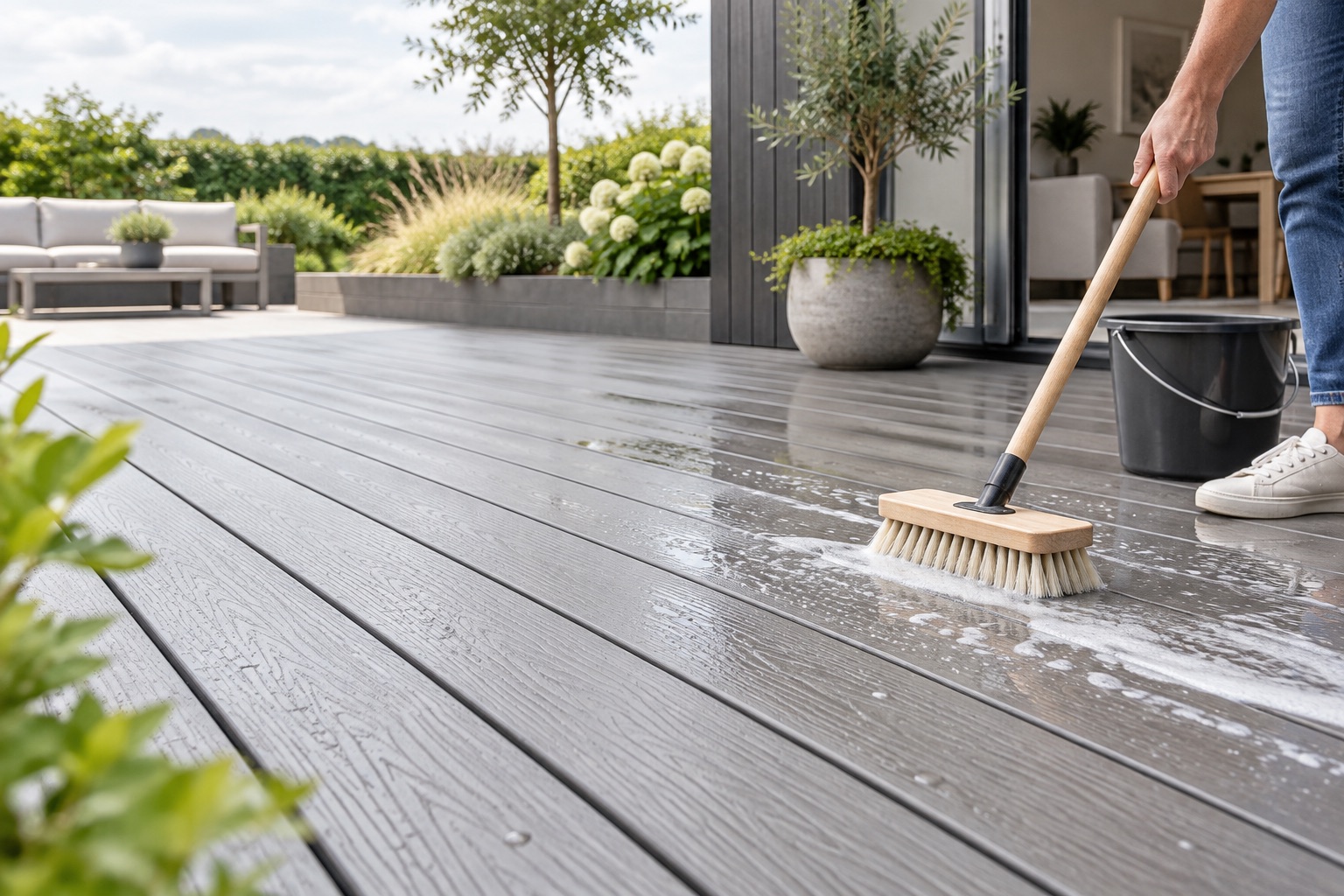
Clean capped and uncapped composite decking with warm soapy water and a soft brush, following the exact board maker’s limits for stains and pressure washing.
Useful products for the job
Choose a board-safe brush
Check your composite maker's bristle and detergent guidance before cleaning; a pressure washer is optional, not the default.
 View product on Amazon
Unger Wood & Composite Deck Brush with Pole
Best for: Manual cleaning of wood and composite deck boards with a supplied telescopic pole
This bundle pairs the dual-bristle, swivelling deck brush with an adjustable telescopic pole. Gentler centre bristles clean board faces while firmer seam bristles reach gaps. Follow the board maker's cleaning guidance.
Check the composite manufacturer's approved brush guidance and test on an inconspicuous board.
- Dual-bristle head
- Swivelling brush
- Wood and composite
- Telescopic pole included
Product-specific care
Find the brand, range and approximate generation
Composite boards combine polymers and fibres in different constructions. Some have a protective cap, some are uncapped and others are PVC rather than wood composite. Care instructions can change between generations sold under the same brand. Look for invoices, installation notes, spare boards or markings underneath.
Inspect for cracked caps, deep scratches, movement and hot-object damage. Cleaning will not repair these defects. Contact the installer before treating a board that may be subject to a product warranty.
| Problem | First method | Product check | Avoid |
|---|---|---|---|
| Loose dirt | Sweep with a soft broom | None normally needed | Metal scrapers |
| General grime | Warm soapy water and soft brush | Confirm detergent compatibility | Letting suds dry |
| Food or grease | Blot then wash promptly | Use maker-approved degreaser | Solvents |
| Mould or mildew | Clean debris and use labelled treatment | Check cap and warranty guidance | Chemical mixtures |
| Ice or snow | Follow board-maker advice | Use approved de-icer only | Sharp metal tools |
Routine composite-deck cleaning
- Remove furniture and sweep. Lift gritty debris instead of dragging it under chair legs or a brush.
- Test warm soapy water. Use the detergent type accepted by the board maker and check an inconspicuous area.
- Brush with the pattern. A soft-bristle brush reaches embossed grain without scratching the cap.
- Rinse promptly. Work in manageable sections and remove all suds before they dry into a film.
- Let the surface dry evenly. Only then judge colour and repeat a gentle treatment if needed.
Clean spills as soon as practical. Composite absorbs less than bare timber, but grease, sunscreen, food and tannin-rich leaves can still mark a textured surface.
Use stain guidance written for the exact board
Blot grease rather than spreading it, then use warm soapy water or the manufacturer-approved cleaner. For biological growth, first remove the damp debris feeding it. Use only a labelled treatment permitted by the board maker, and keep runoff away from drains, ponds and planting as directed.
Do not assume household bleach, solvent, abrasive powder or homemade mixtures are safe. They can lighten the cap, leave a sheen difference or affect a warranty.
Low-force cleaning
A brush-led outdoor cleaner may be enough
The Bosch Fontus 18V pairs 20-bar maximum output with a SmartBrush and built-in tank, making it suited to light controlled maintenance where its brush is accepted by the board maker. The compact AVA Go P40 Medium provides a broad fixed nozzle for products whose care guide explicitly allows pressure washing. Always follow the board limit, not the machine maximum.
 View product on Amazon
Bosch Fontus 18V
Best for: Cars, bikes and furniture where a tap or socket is inconvenient
A wheeled cordless outdoor cleaner with a 15-litre built-in tank, adjustable output and four spray patterns. Its 20-bar pressure suits controlled rinsing rather than large-patio restoration.
What stands out
- 15-litre built-in water tank
- Four spray patterns
- Up to 60 minutes quoted with the recommended battery
Keep in mind
- The selected Amazon listing excludes battery and charger
- 20 bar is not intended for heavy paved-area cleaning
- 20 bar max
- 15 l tank
- 4 m hose
- 18 V battery
 View product on Amazon
AVA Go P40 Medium
Best for: Cars, bikes and smaller outdoor areas where storage space is tight
A genuinely compact 120-bar mains washer with an 8 m flexible hose and 390 l/h flow. The small body and stored accessories make it appealing for sheds, garages and mobile car-care setups.
What stands out
- Compact body with stored accessories
- 8 m flexible hose
- Ten-year warranty when registered under AVA's terms
Keep in mind
- No surface cleaner in the Medium bundle
- Lower flow than the mid-range corded leaders here
- 120 bar max
- 390 l/h
- 8 m hose
- Mains · 1.7 kW
For the pressure-washing decision, see can you pressure wash decking? Timber owners should use the separate wood-deck method.
Do not sand, scrape or concentrate the jet
Trex advises against sanding its composite boards because it changes the surface. Treat this as a default stop unless your own board maker explicitly says otherwise. Avoid wire brushes, metal shovels and pressure-washer rotary nozzles for the same reason.
Trex permits a fan tip within a stated limit and distance on several current product ranges while warning against pressure washing early-generation products. This difference within one brand is why identification comes before equipment.
Manufacturer care example
Trex’s UK care and cleaning guide describes soap-and-brush maintenance, range-specific pressure-washer limits and older-board restrictions. Use the equivalent official guide for the composite installed at your home.
Take the plan outside
Delicate outdoor-surface cleaning checklist
For reachable glass, coatings, render, composite and vulnerable stone. This is a readiness check, not blanket approval for pressure washing or a chemical.
For this job: Check the exact board range and generation. Do not sand the cap or transfer timber-oiling preparation to composite.
Tick on screen or leave blank to tick on paper. Nothing is saved or submitted. Printing includes this checklist only.
Exact model / material / product:
Notes / conditions:
Care references: K Rend: system-specific maintenance, not universal render approval; HSE: ground-level window-cleaning access; Historic England: hazards in older homes. Checked September 2026. Your exact manual, material guidance and current label take priority.
Frequently asked questions
Can you pressure wash composite decking?
Only when the exact board maker allows it. Limits can differ by range and age. Use the specified fan tip, maximum pressure and minimum distance.
Can I use bleach on composite decking?
Not unless the manufacturer and cleaner label explicitly permit it. Strong bleach can discolour boards and harm nearby plants or drainage.
Can composite decking be sanded?
Usually not. Sanding can remove a protective cap or permanently alter embossed colour and texture. Follow the board maker’s repair advice.
How do I remove grease from composite boards?
Blot promptly, wash with warm soapy water and a soft brush, then use only a manufacturer-approved degreaser if a mark remains.
Why does composite decking look streaky after cleaning?
Cleaner residue, uneven drying, hard-water marks or partially lifted dirt can cause streaks. Rinse the full section thoroughly and let it dry before repeating treatment.