
Decking decision guide
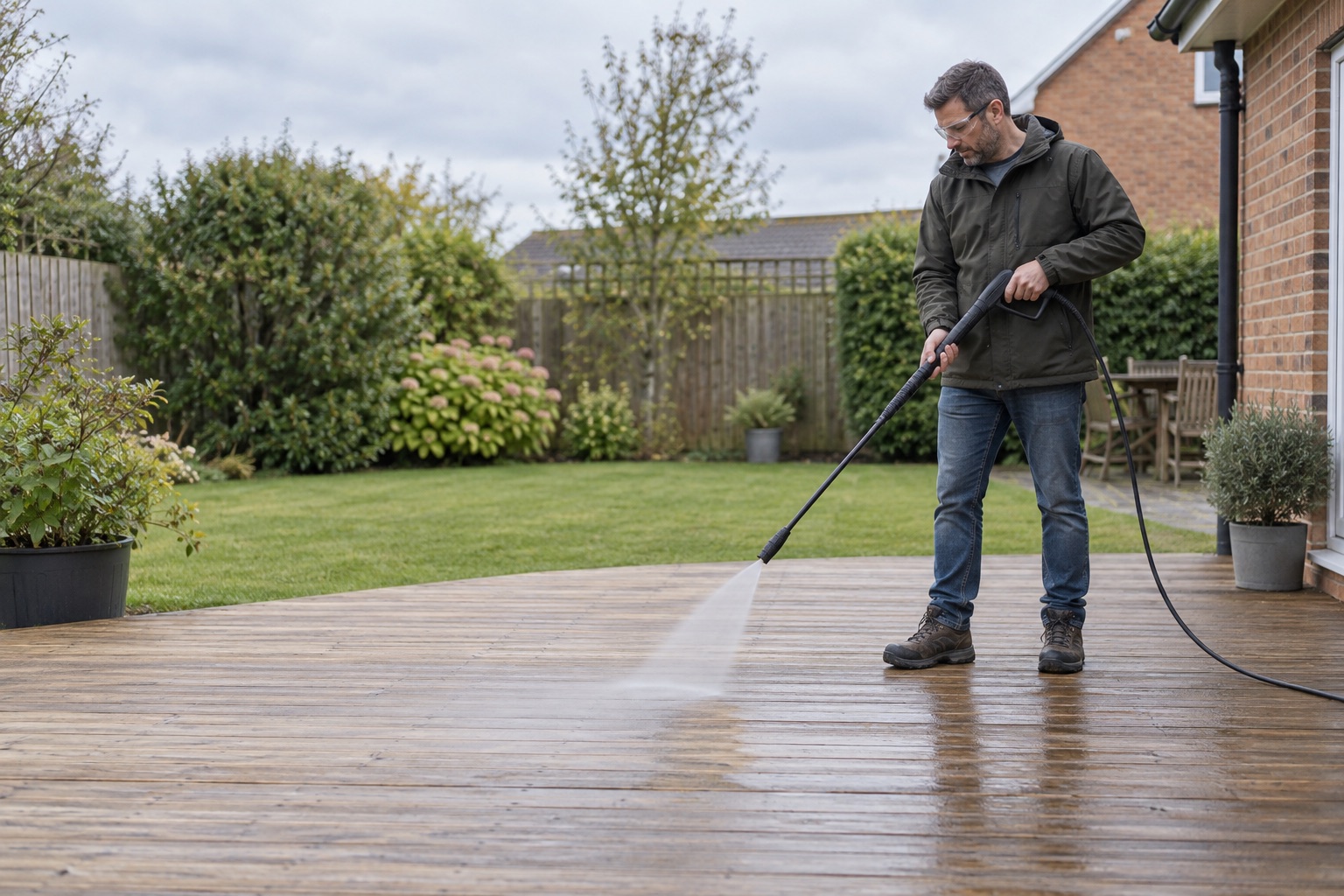
Can you pressure wash decking?
Decide whether timber or composite decking can be pressure washed, which conditions rule it out and how to test a broad low-pressure fan safely.
Useful products for the job
Check the manual route first
A board-appropriate brush and timber-specific cleaner may be a better starting point than a pressure washer. The cleaner is for timber, not composite.
 View product on Amazon
Unger Wood & Composite Deck Brush with Pole
Best for: Manual cleaning of wood and composite deck boards with a supplied telescopic pole
This bundle pairs the dual-bristle, swivelling deck brush with an adjustable telescopic pole. Gentler centre bristles clean board faces while firmer seam bristles reach gaps. Follow the board maker's cleaning guidance.
Check the composite manufacturer's approved brush guidance and test on an inconspicuous board.
- Dual-bristle head
- Swivelling brush
- Wood and composite
- Telescopic pole included
 View product on Amazon
Ronseal Decking Cleaner 5L
Best for: Cleaning and reviving timber boards before a compatible finish
A deck-specific cleaner for weathered hardwood and softwood. Scrub according to the label, rinse thoroughly and allow the boards to dry fully before oiling.
Use on timber decking after a patch test; check old coatings and the chosen finish instructions.
- 5 l
- Timber decking
- Scrub then rinse
- Patch test
Start with the boards
Pressure washing is a surface decision, not a shortcut
Identify whether the deck is softwood, hardwood, capped composite, uncapped composite or PVC. Then inspect fixings, edges, end grain, splits, rot, loose boards and coatings. Pressure washing is not suitable where the surface is already failing or where the manufacturer prohibits it.
Even a machine with adjustable output can damage decking when the nozzle is held too close, paused over a mark or aimed into gaps. Sweep and wash manually first. The pressure washer, if permitted, should be a controlled rinse for remaining grime rather than the primary scrubbing tool.
| Deck condition | Decision | Main risk | Better first step |
|---|---|---|---|
| Sound unfinished timber | Possible with care | Raised grain and striping | Soap and brushing |
| Soft weathered or splintered timber | Avoid | Fibre loss and gouging | Repair then manual clean |
| Painted or coated boards | Check finish maker | Lifting the coating | Mild wash and hand rinse |
| Known composite product | Follow its exact care guide | Cap damage or warranty issue | Warm soapy water |
| Unknown composite or PVC boards | Avoid until identified | Permanent marking | Ask supplier or installer |
Timber can bruise, feather and splinter
Soft springwood erodes faster than dense grain, so an aggressive jet can leave a ridged surface. The Timber Decking & Cladding Association advises low pressure and keeping the lance well back if a washer is used. Work with the grain using a broad fan and smooth full-board passes.
Do not chase dark marks by moving closer. They may be ingrained weathering, metal staining or biological growth that needs a compatible cleaner. After washing, let the deck dry and inspect from several angles before considering sanding or a finish.
Composite guidance varies by product generation
Composite is not automatically pressure-washer safe. Trex, for example, allows controlled fan-tip washing on certain newer ranges within stated pressure and distance limits, but advises against it on early-generation products because damage and warranty consequences can result. Other brands set different rules.
Find the board name from invoices, spare pieces or underside markings. Until then, use warm soapy water and a soft-bristle brush. Never sand composite boards unless the manufacturer explicitly directs it; sanding can permanently change a capped or embossed face.
Control before power
Decking-friendly choices have predictable low settings
The Kärcher K 4 Power Control Flex provides adjustable output and a flexible hose, while the compact AVA Go P40 Medium includes a 25-degree nozzle. The Bosch Fontus 18V is a 20-bar outdoor cleaner with a brush and four spray patterns, useful where a gentle self-contained rinse is more appropriate than mains pressure.
 View product on Amazon
Kärcher K 4 Power Control Flex
Best for: Mixed household cleaning where control and an 8 m flexible hose matter
A balanced mains machine for patios, cars and general outdoor work. Its useful advantage is not extreme pressure but adjustable output, a flexible 8 m hose and a stable mid-range flow rate.
What stands out
- 20–130 bar adjustment
- 8 m PremiumFlex hose
- 420 l/h maximum flow
Keep in mind
- The base package does not include a surface cleaner
- At 12.1 kg before accessories it is not the lightest option
- 20–130 bar
- 420 l/h
- 8 m hose
- Mains · 1.8 kW
 View product on Amazon
AVA Go P40 Medium
Best for: Cars, bikes and smaller outdoor areas where storage space is tight
A genuinely compact 120-bar mains washer with an 8 m flexible hose and 390 l/h flow. The small body and stored accessories make it appealing for sheds, garages and mobile car-care setups.
What stands out
- Compact body with stored accessories
- 8 m flexible hose
- Ten-year warranty when registered under AVA's terms
Keep in mind
- No surface cleaner in the Medium bundle
- Lower flow than the mid-range corded leaders here
- 120 bar max
- 390 l/h
- 8 m hose
- Mains · 1.7 kW
 View product on Amazon
Bosch Fontus 18V
Best for: Cars, bikes and furniture where a tap or socket is inconvenient
A wheeled cordless outdoor cleaner with a 15-litre built-in tank, adjustable output and four spray patterns. Its 20-bar pressure suits controlled rinsing rather than large-patio restoration.
What stands out
- 15-litre built-in water tank
- Four spray patterns
- Up to 60 minutes quoted with the recommended battery
Keep in mind
- The selected Amazon listing excludes battery and charger
- 20 bar is not intended for heavy paved-area cleaning
- 20 bar max
- 15 l tank
- 4 m hose
- 18 V battery
Compare the full shortlist in best pressure washers for decking, or skip the machine with our manual decking method.
A cautious test method
- Sweep and hand-wash a hidden section first.
- Set a wide fan and the lowest available output. Leave rotary and pencil nozzles aside.
- Stand well back, start off the deck and bring the fan onto one sound board.
- Move continuously with the grain, keeping angle and distance consistent.
- Rinse rather than dwell, then let the test patch dry fully.
- Stop if fibres stand up, the coating lifts, embossing dulls or the colour becomes uneven.
Wear eye protection and slip-resistant footwear. Keep electrical connections dry and never direct water beneath doors, into wall junctions or at lighting and sockets.
Board-maker guidance comes first
The TDCA’s timber-deck cleaning advice covers low-pressure technique and damage risk. Trex’s care instructions show why composite range and generation must be identified before washing.
Frequently asked questions
What pressure should I use on timber decking?
There is no universal number. Use the lowest setting, a broad fan and generous distance, then inspect a dry test patch. Timber species and condition change the limit.
Can I use a turbo nozzle on decking?
No. Its concentrated rotating jet can gouge timber, raise fibres and mark composite surfaces.
Should I pressure wash before oiling?
Only if the timber and finish guidance allow it. The deck must then be clean, evenly prepared and completely dry before oil is applied.
Can pressure washing remove decking paint?
It can lift weak paint unevenly, but that is not a controlled stripping method. Use the coating maker’s specified remover and preparation system.
Why is my deck furry after pressure washing?
The jet has raised or torn wood fibres. Let the timber dry, assess the damage and follow the intended finish system’s sanding guidance before recoating.