
Block paving guide
How to pressure wash block paving
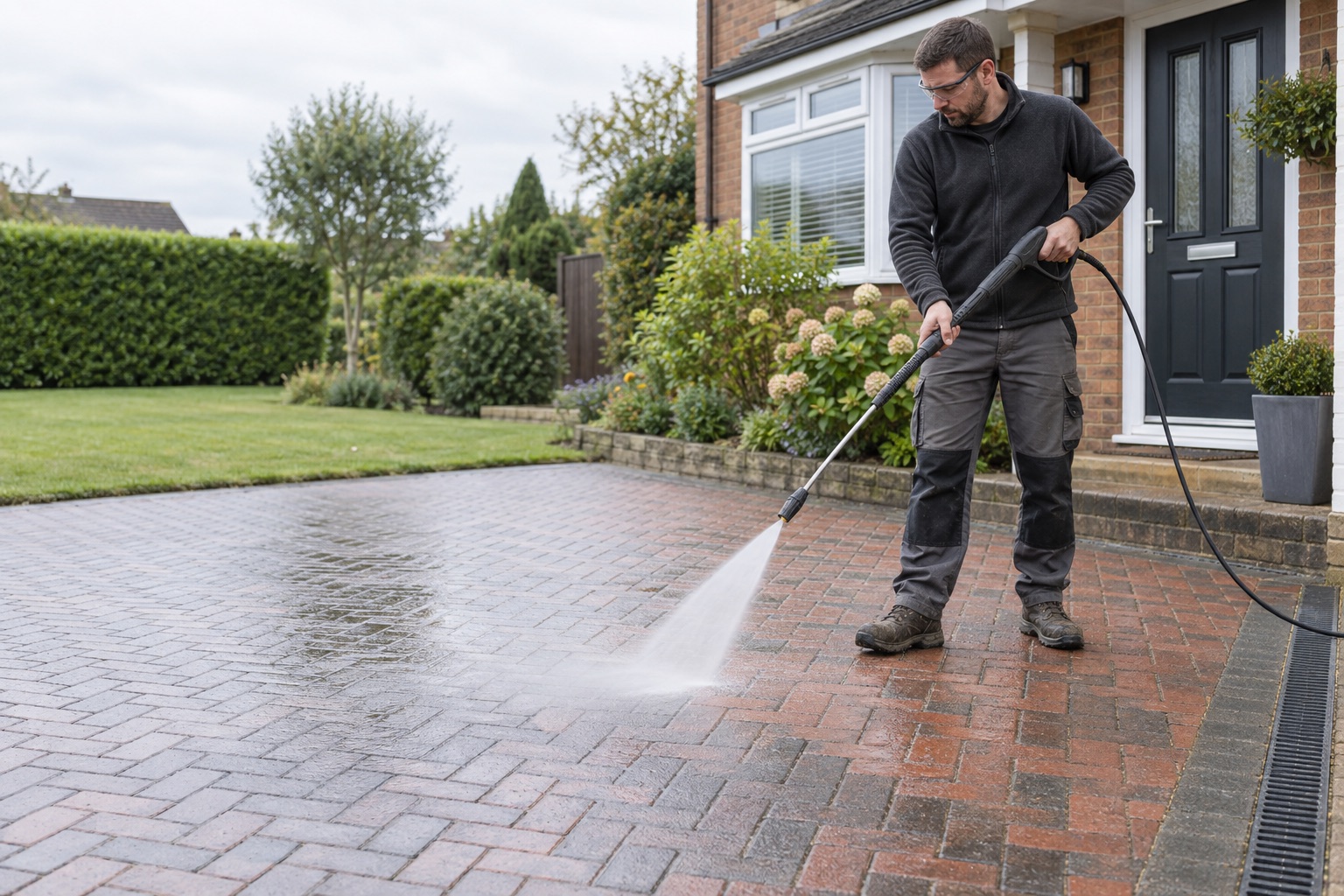
Pressure wash a block-paved driveway without cutting into the blocks or emptying the joints, then plan the right drying and re-sanding sequence.
Useful products for the job
Plan for the joints after washing
Conventional flexible blocks may need dry jointing sand once fully dry; first verify the paving's original jointing system.
 View product on Amazon
Laeto Kiln Dried Paving Sand 20kg
Best for: Refilling dry joints in conventional flexible block paving
Fine, dry jointing sand to brush into conventional block-paving joints once the whole joint depth has dried after cleaning. Confirm your installation uses this type of jointing material.
Not a substitute for proprietary permeable, resin or rigid jointing systems.
- 20 kg bag
- Kiln dried
- For block joints
- Apply dry
Preparation first
Check the joints, levels and drainage
Block paving is a system of individual units held laterally by filled joints and edge restraints. The blocks may tolerate controlled washing while the jointing sand does not. Before connecting a machine, sweep the driveway and inspect for low sand, rocking blocks, failed edges, settlement and blocked channels. Repair or investigate movement first; cleaning cannot correct a failed base.
Move cars, pots and furniture well away. Protect doors, air bricks and vulnerable walls from overspray. Lift leaves and grit from channel drains, but do not push silt, detergent or oily residue into them. Plan to collect heavy debris while it is still on the surface.
| What you find | Best starting method | Main risk | Next step |
|---|---|---|---|
| Sound blocks and full joints | Broad fan at low pressure | Uneven striping | Increase only after a dry check |
| Shallow or empty joints | Manual brushing and gentle rinse | Further sand loss | Re-sand before heavy traffic |
| Loose or rocking blocks | Stop and investigate the bed | Making movement worse | Repair before cleaning |
| Oil or fuel staining | Surface-specific treatment | Spreading contamination | Contain residue and follow the label |
| White deposits or colour change | Diagnose before washing | Treating efflorescence as dirt | Ask the paving supplier if unsure |
A controlled block-paving cleaning sequence
- Pre-clean. Sweep in several directions and spot-treat only with a product labelled for the paving and stain.
- Set a broad fan. Begin at low pressure, keep the nozzle at least a sensible working distance from the blocks and test an inconspicuous corner.
- Work diagonally. Hold the lance at roughly an oblique angle and cross joints rather than following them. Keep every pass moving.
- Clean a complete section. Use overlapping passes from the high side towards a controlled collection point. Avoid repeatedly chasing one stubborn mark.
- Rinse gently. Move released grime without driving it into joints, borders or drainage channels.
- Let it dry. Dry blocks reveal striping, fresh marks and the true joint level far better than wet paving.
Marshalls advises a test patch, no more than medium pressure, an oblique lance angle and a distance of at least 200 mm for its paving guidance. Treat those figures as a manufacturer reference, not permission for every installation: older, damaged or differently made paving may need a gentler method.
Use flow and control, not a close rotary jet
A wide fan spreads force and makes it easier to clean evenly. A rotary or pencil jet concentrates impact into a small point, which can mark a block face and rapidly excavate joints. If a broad fan will not shift a patch, pause and identify the stain instead of shortening the working distance.
A compatible surface-cleaner head can reduce overspray on a large, flat, sound driveway, but it can still remove jointing sand and may hide what is happening underneath. Lift it periodically and inspect. Around edges, channels, inspection covers and steps, return to a controllable fan.
Useful control
Pressure washers suited to measured driveway work
The Nilfisk Core 140 PowerControl and Kärcher K 4 Power Control Flex both make deliberate output adjustment central to the setup. The Bosch UniversalAquatak 135 combines 450 l/h maximum flow with a compact body. Exact bundles vary, so check whether the surface head you want is actually included rather than relying on a listing photograph.
 View product on Amazon
Nilfisk Core 140 PowerControl
Best for: Users who value in-hand adjustment and a lighter trolley format
A light trolley-format washer with power adjustment for mixed-garden jobs. The current Amazon page conflicts on supplied hose length, so confirm the exact bundle before buying it for reach.
What stands out
- Power adjustment
- Compact trolley format
- Useful mid-range output
Keep in mind
- Bundles differ between retailers
- A surface cleaner may still be an extra purchase
- 140 bar max
- 40 m²/h listed
- Confirm hose length
- Mains · 1.8 kW
 View product on Amazon
Kärcher K 4 Power Control Flex
Best for: Mixed household cleaning where control and an 8 m flexible hose matter
A balanced mains machine for patios, cars and general outdoor work. Its useful advantage is not extreme pressure but adjustable output, a flexible 8 m hose and a stable mid-range flow rate.
What stands out
- 20–130 bar adjustment
- 8 m PremiumFlex hose
- 420 l/h maximum flow
Keep in mind
- The base package does not include a surface cleaner
- At 12.1 kg before accessories it is not the lightest option
- 20–130 bar
- 420 l/h
- 8 m hose
- Mains · 1.8 kW
 View product on Amazon
Bosch UniversalAquatak 135
Best for: Smaller homes wanting one compact machine with a multi-pattern nozzle
A compact 135-bar washer with a strong 450 l/h maximum flow and a practical three-in-one nozzle. It reduces attachment swapping for routine car, furniture and small-patio jobs.
What stands out
- 450 l/h maximum flow
- Three spray patterns in one nozzle
- 7.9 kg machine weight
Keep in mind
- No surface cleaner in the standard box
- The 7 m PVC hose is shorter and less flexible than some rivals
- 135 bar max
- 450 l/h
- 7 m hose
- Mains · 1.9 kW
Compare reach and bundle details in our driveway pressure-washer guide and read the surface-cleaner guide before adding an enclosed head.
Re-sand only when the paving is fully dry
Some joint loss is common even with careful washing. Once the blocks and joints are dry through, brush the correct fine kiln-dried jointing sand over the paving in several directions so it falls into the gaps. Compact and top up only as the paving or installer’s instructions require. Do not substitute building sand or sweep over damp joints, where material can bridge at the top instead of filling the depth.
Our full block-paving re-sanding guide explains quantities, dry-weather timing and the final checks before vehicles return.
Technical guidance worth keeping beside the job
Marshalls’ paving technical guidance covers test cleaning, lance position and replacing displaced joint material. Its joint-filling guidance describes kiln-dried sand intended to flow into block-paving joints.
Frequently asked questions
Will pressure washing remove the sand between blocks?
It can. A broad fan, oblique angle and diagonal passes reduce loss but do not guarantee the joints will remain full. Inspect after drying and replenish with the specified material.
Should I use a rotary nozzle on block paving?
It is usually an unnecessarily aggressive starting point. A wide fan gives more control and a lower risk of etched blocks, empty joints and visible stripes.
Can I pressure wash weeds out of the joints?
Do not use the jet as a joint excavator. Remove established growth carefully, clean across rather than down the joints, and restore the correct sand once dry.
Can I seal block paving immediately after washing?
No. The paving must be clean, correctly re-sanded and dry to the sealer maker’s requirements. Trapped moisture or incompatible jointing can spoil the finish.
How often should block paving be pressure washed?
Use condition rather than a fixed calendar. Regular sweeping and prompt spot cleaning often delay the need for a full machine clean.