
Timber decking guide
How to clean timber decking
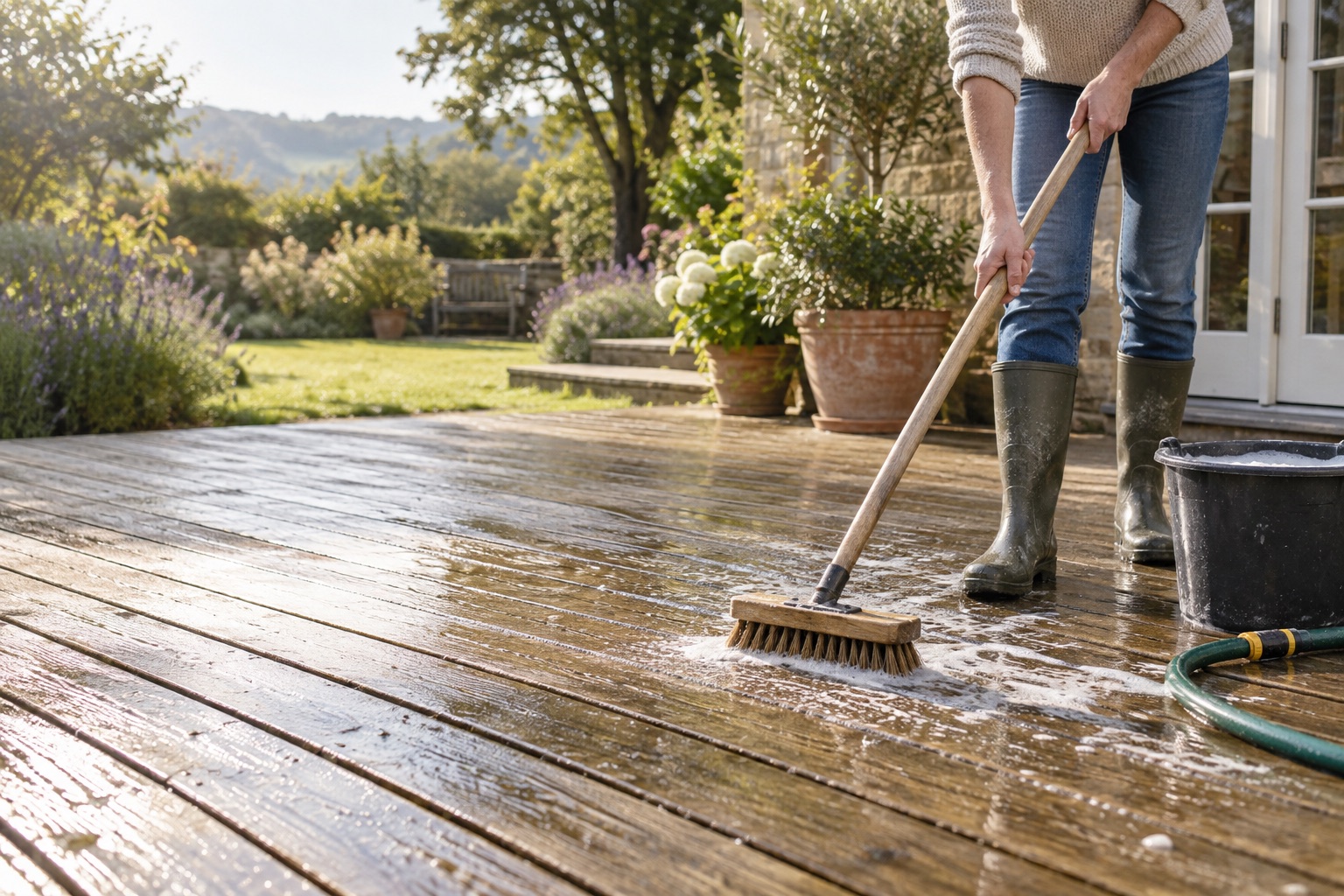
Clean softwood or hardwood decking with sweeping, compatible detergent and careful brushing, using low pressure only when the timber condition allows it.
Useful products for the job
Timber cleaner and brush come first
Scrub and rinse as the cleaner label directs; use powered rinsing only where the timber maker allows it.
 View product on Amazon
Ronseal Decking Cleaner 5L
Best for: Cleaning and reviving timber boards before a compatible finish
A deck-specific cleaner for weathered hardwood and softwood. Scrub according to the label, rinse thoroughly and allow the boards to dry fully before oiling.
Use on timber decking after a patch test; check old coatings and the chosen finish instructions.
- 5 l
- Timber decking
- Scrub then rinse
- Patch test
 View product on Amazon
Unger Wood & Composite Deck Brush with Pole
Best for: Manual cleaning of wood and composite deck boards with a supplied telescopic pole
This bundle pairs the dual-bristle, swivelling deck brush with an adjustable telescopic pole. Gentler centre bristles clean board faces while firmer seam bristles reach gaps. Follow the board maker's cleaning guidance.
Check the composite manufacturer's approved brush guidance and test on an inconspicuous board.
- Dual-bristle head
- Swivelling brush
- Wood and composite
- Telescopic pole included
Preparation first
Inspect boards, gaps and fixings in dry light
Move furniture and pots rather than cleaning around them. Sweep leaves from between boards and check for proud screws, loose nails, splinters, decay and movement. Pay particular attention to shaded areas, steps and the junction with the building. Repair unsafe boards before making the deck wet and slippery.
Identify any existing oil, stain or paint. A maintenance wash, preparation for recoating and complete finish removal are different jobs. Use products from a compatible timber-care system rather than combining unrelated cleaners and coatings.
| What you see | Likely need | Avoid | Follow-up |
|---|---|---|---|
| Loose dust and leaves | Sweep and clear gaps | Wetting unnecessarily | Inspect fixings |
| Grey general grime | Mild cleaner and brush | Close aggressive jet | Rinse and dry |
| Green slippery film | Labelled timber treatment | Chemical mixtures | Correct shade and drainage |
| Flaking coating | Finish-system preparation | Washing under loose edges | Strip or repair as directed |
| Rot or deep splintering | Board repair or replacement | Cosmetic cleaning first | Check structure |
How to clean a timber deck
- Choose a workable day. Avoid hot sun that dries cleaner onto the boards and plan enough drying weather afterwards.
- Protect the surroundings. Follow the cleaner label for plants, walls, metalwork, pets and runoff.
- Test the system. Apply the diluted cleaner to a hidden board and check colour once dry.
- Work in small sections. Agitate with a medium non-metal brush along the grain. Keep to the labelled dwell time.
- Rinse completely. Use a garden hose or permitted low-pressure fan without flooding the building edge.
- Let the deck dry. Judge colour, fibre condition and remaining marks only when moisture is even.
Treat biological growth and metal marks differently
Algae creates a slip hazard and usually signals persistent damp, shade or trapped debris. Remove the growth with a timber-labelled treatment and improve air movement and drainage where possible. Do not mix biocide with other cleaners or let it enter drains and ponds.
Dark marks around steel fixings can be a chemical reaction rather than dirt. Random bleaching or harder scrubbing may make them more obvious. Check the timber and coating supplier’s stain guidance before treatment.
Gentle rinsing options
Use machine control only after the brush stage
Kärcher’s K 4 Power Control Flex and the AVA Go P40 Medium can be set up with broad fans and useful hose reach for sound decks where pressure washing is permitted. The 20-bar Bosch Fontus 18V is a lower-output alternative with a SmartBrush for light maintenance. None should be used to compensate for the wrong cleaner or failing timber.
 View product on Amazon
Kärcher K 4 Power Control Flex
Best for: Mixed household cleaning where control and an 8 m flexible hose matter
A balanced mains machine for patios, cars and general outdoor work. Its useful advantage is not extreme pressure but adjustable output, a flexible 8 m hose and a stable mid-range flow rate.
What stands out
- 20–130 bar adjustment
- 8 m PremiumFlex hose
- 420 l/h maximum flow
Keep in mind
- The base package does not include a surface cleaner
- At 12.1 kg before accessories it is not the lightest option
- 20–130 bar
- 420 l/h
- 8 m hose
- Mains · 1.8 kW
 View product on Amazon
AVA Go P40 Medium
Best for: Cars, bikes and smaller outdoor areas where storage space is tight
A genuinely compact 120-bar mains washer with an 8 m flexible hose and 390 l/h flow. The small body and stored accessories make it appealing for sheds, garages and mobile car-care setups.
What stands out
- Compact body with stored accessories
- 8 m flexible hose
- Ten-year warranty when registered under AVA's terms
Keep in mind
- No surface cleaner in the Medium bundle
- Lower flow than the mid-range corded leaders here
- 120 bar max
- 390 l/h
- 8 m hose
- Mains · 1.7 kW
 View product on Amazon
Bosch Fontus 18V
Best for: Cars, bikes and furniture where a tap or socket is inconvenient
A wheeled cordless outdoor cleaner with a 15-litre built-in tank, adjustable output and four spray patterns. Its 20-bar pressure suits controlled rinsing rather than large-patio restoration.
What stands out
- 15-litre built-in water tank
- Four spray patterns
- Up to 60 minutes quoted with the recommended battery
Keep in mind
- The selected Amazon listing excludes battery and charger
- 20 bar is not intended for heavy paved-area cleaning
- 20 bar max
- 15 l tank
- 4 m hose
- 18 V battery
Read when pressure washing is appropriate and compare current options in our decking machine guide.
Dry fully before sanding or coating
The TDCA advises allowing timber to dry after cleaning before further treatment. Drying time depends on species, board thickness, shade, airflow and recent weather, so use the finish maker’s moisture and weather requirements rather than a fixed online timetable.
If fibres have lifted, follow the chosen coating system’s sanding instructions and remove dust completely. If oil is next, use our deck preparation for oiling guide. Do not seal visible dampness or biological growth beneath a fresh finish.
Timber-industry guidance
The Timber Decking & Cladding Association recommends regular sweeping, mild soap and brushing, and warns that pressure washing can bruise or damage timber unless pressure is low and the lance is held back.
Frequently asked questions
What is the best way to clean wooden decking?
Start with sweeping, a timber-compatible mild cleaner and brushing with the grain. Rinse thoroughly and use pressure only if the board condition and maker allow it.
Can I clean decking with washing-up liquid?
Use a product the timber or finish supplier accepts. Household detergents can leave residue or conflict with a later coating, so a labelled deck cleaner is easier to use correctly.
How do I stop decking becoming slippery?
Remove leaves promptly, clear gaps, improve drainage and light where practical, and clean biological growth with an authorised compatible treatment.
Should I sand decking after cleaning?
Only when dry and when the intended finish system calls for it. Sanding may be needed for lifted fibres or coating preparation, but it is not an automatic step after every wash.
How long should decking dry before oiling?
Until the timber meets the oil maker’s moisture and weather requirements. Shade, temperature, airflow and rainfall make one fixed duration unreliable.