
Concrete paving guide
How to clean concrete paving slabs
Clean concrete patio slabs safely with brushing, suitable treatment and controlled pressure while avoiding stripes, surface damage and lost joint material.
Useful products for the job
Scrubbing and controlled coverage
A stiff brush can handle routine grime on sound concrete; the surface head is only for a compatible Kärcher washer and robust slabs.
 View product on Amazon
Newman and Cole Deck Scrubber Brush
Best for: Robust paving and sound timber that tolerate a stiff brush
A long-handled stiff brush for loosening surface dirt without a pressure washer. Test a small patch first; soft stone, delicate pointing and composite boards may need a gentler brush.
Use only where the surface maker permits firm brushing; protect joints and finishes.
- Stiff bristles
- Long handle
- Manual cleaning
- Test first
 View product on Amazon
Kärcher T 5 T-Racer Surface Cleaner
Best for: Broad-area cleaning with a compatible Kärcher K-series washer
A twin-jet enclosed surface head that reduces splash on suitable patios and other robust surfaces. It is an attachment, not a standalone cleaner; confirm the exact washer and nozzle compatibility.
Especially relevant alongside the Kärcher K 4; do not imply it fits Bosch, Nilfisk or AVA machines.
- Twin rotating jets
- Kärcher K-series
- Attachment only
- Check surface
Condition sets the limit
Concrete is robust, but not indestructible
Look for exposed aggregate, a sandy surface, frost damage, cracks, patched areas and old coatings. If rubbing a dry edge releases material, high pressure is likely to accelerate wear. Check every joint and identify any sealant or paint before introducing detergent.
Clear furniture and pots, sweep twice and plan the runoff route. Grit left under a surface cleaner can scour the paving, while dirt pushed against a wall or threshold creates a second clean-up job.
| Condition | Suitable first step | Pressure-washer decision | Watch for |
|---|---|---|---|
| Sound plain concrete | Brush and detergent | Broad fan or surface head | Uneven stripes |
| Weathered exposed face | Gentle hand clean | Test at low pressure only | Further aggregate exposure |
| Painted or sealed slabs | Coating-maker method | Only if explicitly permitted | Dulling or lifting |
| Cracked slab or loose edge | Clean manually around defect | Repair before pressure | Water entering crack |
| Weak mortar joints | Brush across joints | Avoid direct jetting | Lost pointing |
Clean concrete paving in stages
- Dry sweep leaves, soil and loose grit.
- Wet a test section and apply warm detergent solution compatible with the slab and any coating.
- Agitate with a stiff outdoor brush on robust texture, changing to a gentler brush around worn areas.
- Rinse before the solution dries and inspect after drying.
- Escalate to controlled pressure only if embedded grime remains and the test area is sound.
Prevent stripes and surface damage
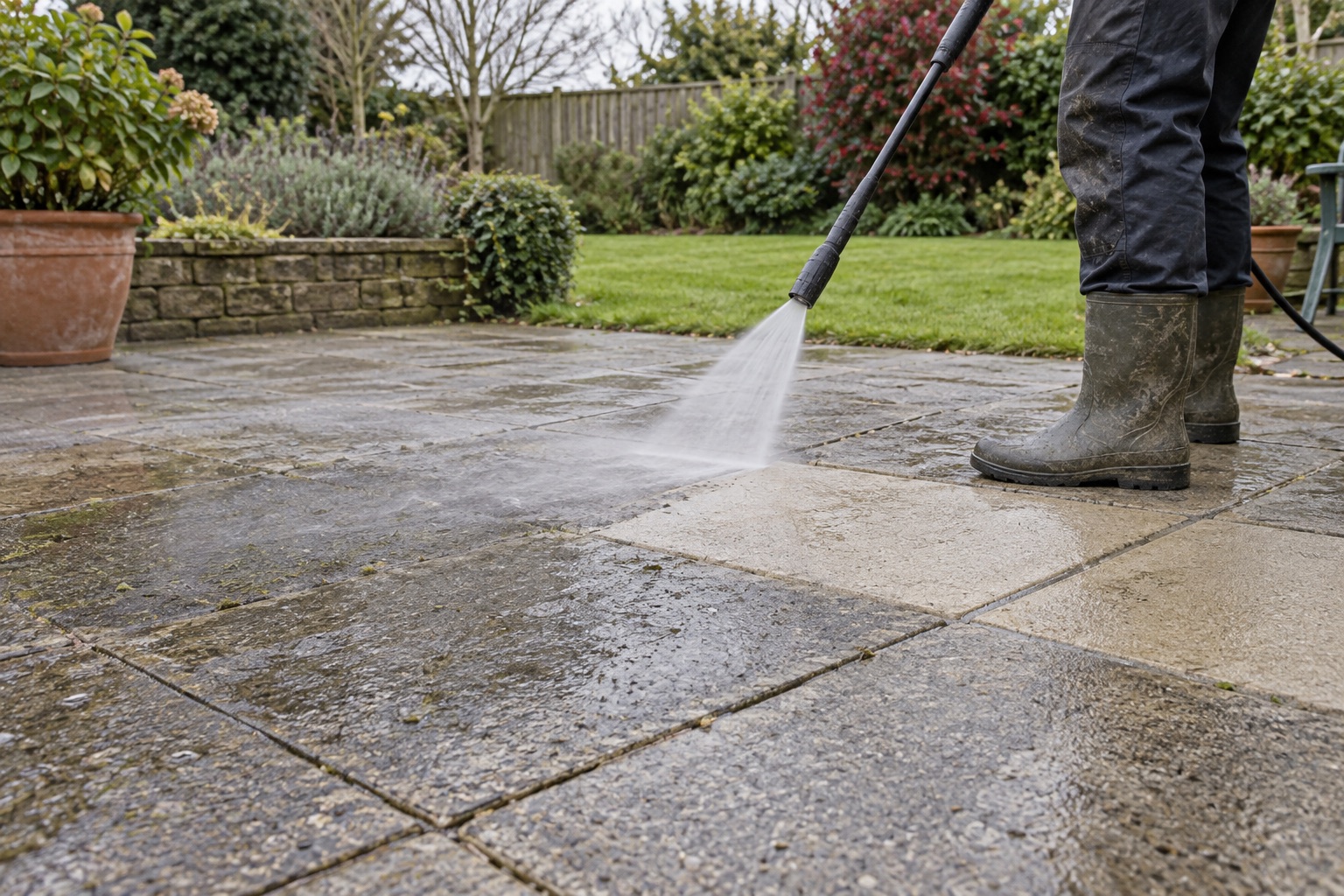
Use a broad fan at consistent distance and speed. Begin each pass off the slab where possible, overlap slightly and avoid stopping the jet on one point. Cross joints diagonally. A correctly matched surface head can give a more uniform result on a large flat patio, but do the edges and steps separately at a lower setting.
Wet concrete can hide pale etched lines. Let the test patch dry before increasing pressure or committing to the whole area. If aggregate becomes newly visible, the face has changed rather than simply become cleaner.
Broad-area options
Flow and control both matter on concrete
The Kärcher K 4 balances adjustable output with a flexible eight-metre hose. The Bosch UniversalAquatak 135 provides 450 l/h maximum flow in a compact body, while the Nilfisk Core 140 lists up to 465 l/h and puts adjustment at the centre of the setup. Check the exact Amazon bundle if a surface head is important.
 View product on Amazon
Kärcher K 4 Power Control Flex
Best for: Mixed household cleaning where control and an 8 m flexible hose matter
A balanced mains machine for patios, cars and general outdoor work. Its useful advantage is not extreme pressure but adjustable output, a flexible 8 m hose and a stable mid-range flow rate.
What stands out
- 20–130 bar adjustment
- 8 m PremiumFlex hose
- 420 l/h maximum flow
Keep in mind
- The base package does not include a surface cleaner
- At 12.1 kg before accessories it is not the lightest option
- 20–130 bar
- 420 l/h
- 8 m hose
- Mains · 1.8 kW
 View product on Amazon
Bosch UniversalAquatak 135
Best for: Smaller homes wanting one compact machine with a multi-pattern nozzle
A compact 135-bar washer with a strong 450 l/h maximum flow and a practical three-in-one nozzle. It reduces attachment swapping for routine car, furniture and small-patio jobs.
What stands out
- 450 l/h maximum flow
- Three spray patterns in one nozzle
- 7.9 kg machine weight
Keep in mind
- No surface cleaner in the standard box
- The 7 m PVC hose is shorter and less flexible than some rivals
- 135 bar max
- 450 l/h
- 7 m hose
- Mains · 1.9 kW
 View product on Amazon
Nilfisk Core 140 PowerControl
Best for: Users who value in-hand adjustment and a lighter trolley format
A light trolley-format washer with power adjustment for mixed-garden jobs. The current Amazon page conflicts on supplied hose length, so confirm the exact bundle before buying it for reach.
What stands out
- Power adjustment
- Compact trolley format
- Useful mid-range output
Keep in mind
- Bundles differ between retailers
- A surface cleaner may still be an extra purchase
- 140 bar max
- 40 m²/h listed
- Confirm hose length
- Mains · 1.8 kW
See the broader patio washer comparison and surface-cleaner buying guide.
Treat oil, algae and rust-like marks separately
Blot fresh oil with an absorbent material and use a concrete-compatible degreaser according to its label; do not wash it into a drain. Remove algae with brushing and a labelled treatment where necessary. For rust-like or unknown stains, test a purpose-made concrete product rather than applying acid to the entire patio.
Marshalls advises hot detergent solution and a stiff broom for general dirt and algae, followed by a clean rinse, and warns against acid concentrations on concrete and natural stone.
Frequently asked questions
Can concrete paving slabs be pressure washed?
Sound, uncoated slabs often can, but inspect first. Use a broad fan below maximum, keep moving and test after drying.
How do I avoid pressure-washer lines on concrete?
Keep distance and speed consistent, use overlapping passes and avoid pausing over one spot. A compatible surface head can help on large flat areas.
Can I use acid to clean concrete slabs?
Avoid general acid cleaning. It can attack cement surfaces and nearby natural stone or metal. Use a product labelled for the specific stain and slab.
Why is aggregate showing after cleaning?
The surface paste may have weathered or been removed by aggressive cleaning. Stop pressure washing and obtain advice before making the appearance more uneven.
Should concrete slabs be sealed after cleaning?
Not automatically. Use only a compatible sealer for the slab and desired finish, after the paving is fully dry and any repairs are complete.