
Limestone care guide
How to clean limestone paving
Clean limestone paving without acid, harsh pressure or avoidable colour change, with safe methods for routine grime, algae and black lichen.
Acid-sensitive stone
Limestone needs a different rulebook from concrete
Limestone is calcium-rich and can be etched or dissolved by acidic cleaners. Avoid brick acid, hydrochloric acid, vinegar and general descalers. Some dark limestone also lightens outdoors through weathering and ultraviolet exposure; cleaning cannot always restore the original wet-looking colour.
Identify the supplier and finish if possible. Inspect for flaking, fine cracks, open joints, pale etched areas and an old sealer. Test every product in an inconspicuous dry area and assess it again after full drying.
| Issue | First method | Do not use | Escalation |
|---|---|---|---|
| Loose dirt | Soft sweep | Abrasive metal brush | Clean water rinse |
| General grime | Approved mild wash and brush | Acidic cleaner | Repeat gentle section |
| Algae | Limestone-safe labelled treatment | Uncontrolled bleach mixture | Improve moisture conditions |
| Black lichen | Specialist compatible product | Close rotary jet | Allow gradual result |
| Faded dark limestone | Supplier assessment | Colour-restoring guesswork | Check stone and sealer history |
A gentle limestone-cleaning sequence
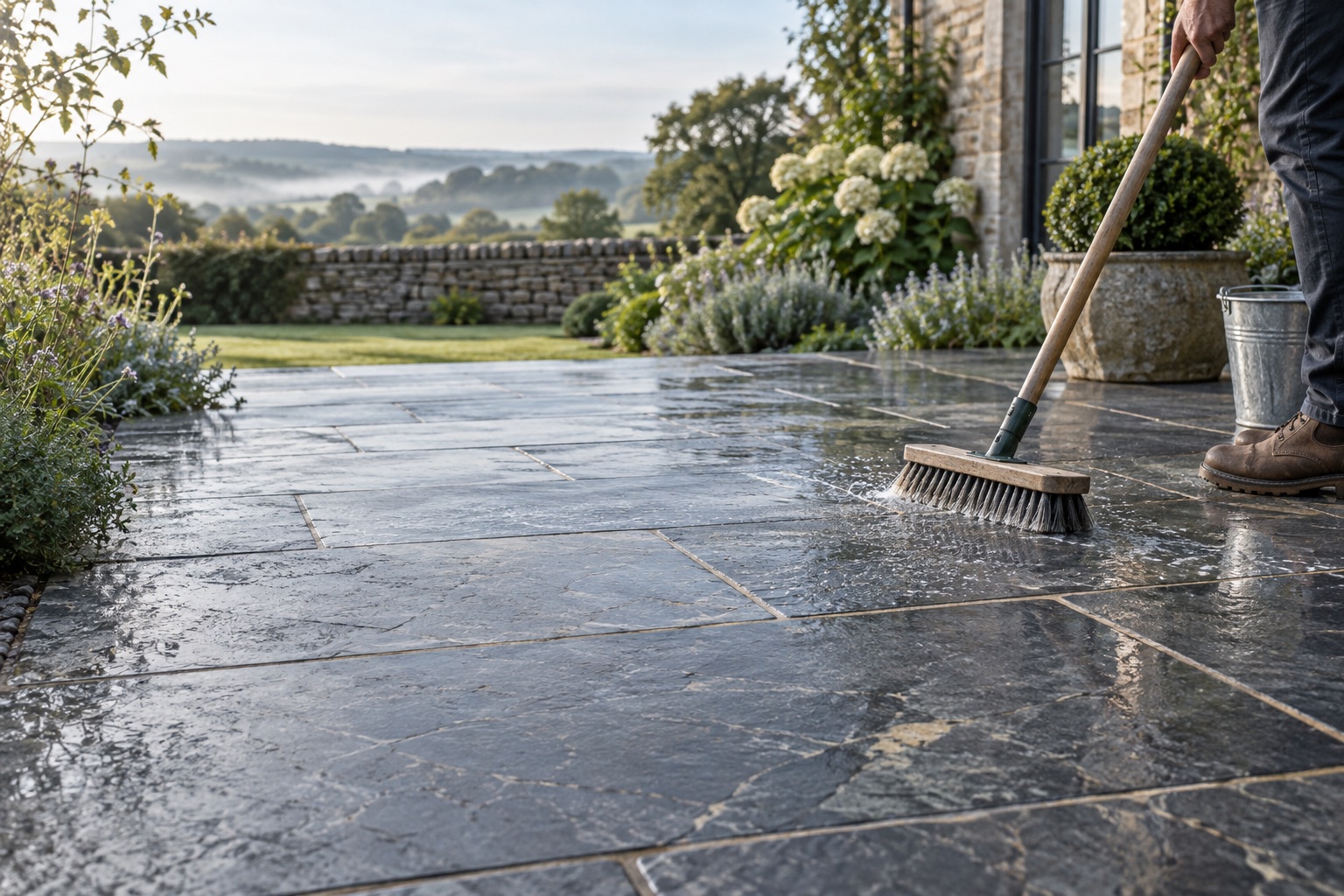
- Dry sweep with a clean soft or medium outdoor broom.
- Wet a small test area with clean water.
- Apply a mild limestone-compatible cleaner at its labelled dilution.
- Agitate without forcing the brush into the joints or rubbing one patch excessively.
- Rinse fully before the solution dries and keep runoff away from drains and planting as directed.
- Wait for the stone to dry before deciding whether a second gentle pass is needed.
Handle growth and staining locally
Green algae responds to brushing, moisture control and, where needed, a limestone-compatible labelled treatment. Black lichen may improve slowly. Unknown orange, white or metallic stains need diagnosis rather than stronger chemistry.
Use our guides to remove patio algae and treat black spots, while keeping limestone’s acid sensitivity as the deciding constraint.
Only where permitted
Use the lowest effective machine setting
The compact AVA Go P40 has a 120-bar maximum and eight-metre hose, while the Kärcher K 4 gives a wider adjustable 20–130 bar range. On limestone, the lower starting point is more important than the maximum. Fit a broad fan, keep well back, cross joints and stop if the face roughens or colour changes.
 View product on Amazon
AVA Go P40 Medium
Best for: Cars, bikes and smaller outdoor areas where storage space is tight
A genuinely compact 120-bar mains washer with an 8 m flexible hose and 390 l/h flow. The small body and stored accessories make it appealing for sheds, garages and mobile car-care setups.
What stands out
- Compact body with stored accessories
- 8 m flexible hose
- Ten-year warranty when registered under AVA's terms
Keep in mind
- No surface cleaner in the Medium bundle
- Lower flow than the mid-range corded leaders here
- 120 bar max
- 390 l/h
- 8 m hose
- Mains · 1.7 kW
 View product on Amazon
Kärcher K 4 Power Control Flex
Best for: Mixed household cleaning where control and an 8 m flexible hose matter
A balanced mains machine for patios, cars and general outdoor work. Its useful advantage is not extreme pressure but adjustable output, a flexible 8 m hose and a stable mid-range flow rate.
What stands out
- 20–130 bar adjustment
- 8 m PremiumFlex hose
- 420 l/h maximum flow
Keep in mind
- The base package does not include a surface cleaner
- At 12.1 kg before accessories it is not the lightest option
- 20–130 bar
- 420 l/h
- 8 m hose
- Mains · 1.8 kW
Follow the full safe patio method and compare controllable patio washers.
Do not use sealer as a cosmetic shortcut
A sealer can change colour, sheen, slip behaviour and future cleaning. It cannot reverse etched stone or repair weak joints. Confirm that the product is intended for the specific limestone, finish and outdoor installation, and allow the paving to dry to the required level.
Bradstone warns never to use acid on limestone and notes that some dark limestone can lighten through UV exposure. Marshalls’ maintenance manual likewise states that hydrochloric acid dissolves limestone.
Frequently asked questions
Can I pressure wash limestone paving?
Only if the paving supplier permits it and the stone and joints are sound. Use a low-pressure fan at generous distance and stop at any surface change.
Can I use vinegar on limestone?
No. Vinegar is acidic and can etch calcium-rich limestone.
Why has black limestone gone grey?
Outdoor weathering and UV exposure can lighten some dark limestone, while unsuitable cleaners may also change it. Identify the cause before considering treatment.
Should I seal limestone after cleaning?
Only with a compatible product after checking how it changes appearance and maintenance. Sealing is not automatically required.
What brush should I use on limestone?
Begin with a clean soft or medium outdoor brush. Avoid wire and highly abrasive tools that may mark the face.