
Brick wall cleaning
How to clean brick walls safely
Clean exterior brick without eroding faces or mortar. Identify the brick and stain, test gentle water and brushing, and know when pressure washing is unsuitable.
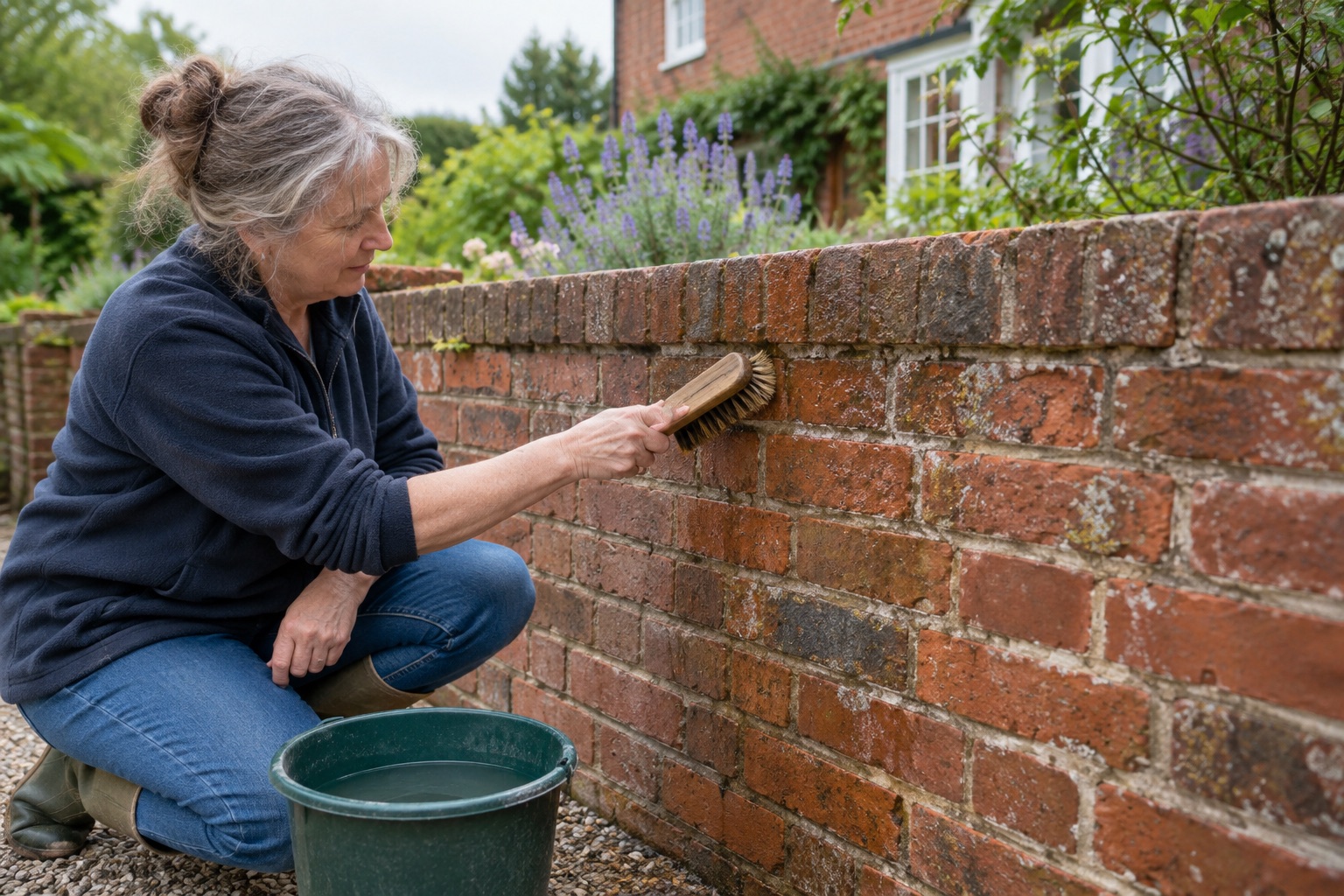
Survey the whole wall, not just the dirty patch
Brick is not uniformly hard. Soft handmade faces, sand-facing, fired skins and old lime mortar can be permanently abraded. Check for open joints, cracked bricks, salt crystals, damp inside the building and loose paint or render at adjoining areas. Do not clean newly built brickwork until the mortar and brick supplier say it is ready.
The Brick Development Association’s cleaning guide warns against pressure washing older brickwork without a detailed condition survey and says never to pressure wash lime mortar. That is a useful default when a wall’s age or mortar is uncertain.
Match the method to the stain
Loose dirt and cobwebs: dry-brush first. Green growth: address shade, plants and water leaks, then use a brick-approved outdoor treatment only if needed. White powder: identify possible efflorescence and solve the moisture source; soaking it repeatedly may bring salts back. Black deposits: distinguish surface soot from embedded pollution; do not jump to acid or abrasive blasting.
If the brick is painted, do not follow bare-brick cleaning advice. Use the painted-masonry guide instead. If there is widespread salt damage or crumbling mortar, arrange a masonry assessment before cosmetic cleaning.
A measured hand-cleaning sequence
- Take photographs and test a hidden area that represents both brick face and mortar.
- Brush loose material gently while dry; do not scrape off the brick’s face.
- Use small amounts of clean water and a soft brush, working top down in manageable sections.
- Keep water away from vents, electrical fittings and open joints. Avoid saturating the wall.
- Allow full drying before deciding whether a stain remains and needs a specialist product.
Always read a treatment label for the particular brick and surrounding materials. Keep chemical runoff out of surface-water drains and away from children, pets and plants as instructed.
Gentle tools and a targeted growth treatment
A soft water-fed brush can make ground-level work more even, but shut down its flow if the wall absorbs water rapidly. Wet & Forget is relevant only for biological growth on label-approved brick, not for soot, salts or mortar repair. A specialist can assess fragile and high elevations safely.
 View product on Amazon
GARDENA Cleansystem Soft Wash Set
Best for: Ground-level cleaning of sound, delicate exterior finishes after a patch test
A 90 cm water-fed handle and soft brush for controlled cleaning of larger sensitive surfaces. Use light contact and check the wall finish maker's guidance; the included cleaning tabs are not automatically suitable for render or paint.
A gentle tool, not a guarantee that a fragile coating or loose render can be scrubbed safely.
- 90 cm handle
- Soft brush
- Adjustable water flow
- Hose connection
 View product on Amazon
Wet & Forget Outdoor Cleaner 5L
Best for: Label-approved outdoor surfaces with algae, mould or lichen
A concentrated outdoor treatment for organic growth on many exterior surfaces. It is a treatment, not an instant pressure-washing substitute; follow the label for dilution, weather and runoff.
Check the exact surface and any sealer with the maker before use; keep it out of ponds and follow plant and pet precautions.
- 5 l concentrate
- Outdoor surfaces
- Organic growth
- Label-led dilution
When is pressure washing brick acceptable?
It is not the default for older brick, lime joints, soft faces or visible defects. If a modern, sound wall and its maker allow a machine, use a cold broad fan at the lowest effective setting, test discreetly and keep a constant generous distance. Never drive the stream directly into joints, vents or openings. Stop immediately if grains, mortar or colour lift.
Read soft washing versus pressure washing to understand the alternatives. For nearby render, the risk profile changes; see our render decision guide.
Frequently asked questions
Can I use a pressure washer on old brick?
Not without a detailed condition survey. Soft faces and old mortar can suffer irreversible damage; manual cleaning or specialist work is usually safer.
Can I pressure wash lime mortar?
No. The Brick Development Association specifically warns against pressure washing lime mortar.
Does vinegar clean brickwork?
Acidic household mixtures can affect brick and mortar. Identify the stain and use a product approved for the masonry rather than guessing.
How do I remove green algae from brick?
Fix the moisture source, gently remove loose growth and use a labelled brick-compatible treatment if needed. Follow all runoff and plant precautions.
What causes white marks on brick?
Often salts carried by moisture, but not every white deposit is efflorescence. Identify and address the water path before repeated cleaning.