
Tarmac driveway guide
How to clean a tarmac driveway without damaging it
Clean a tarmac or asphalt driveway with sweeping, spot treatment and a low-force rinse while avoiding loosened aggregate, softened binder and damaged edges.
Know the construction
Not every black driveway is maintained the same way
“Tarmac” is commonly used for several asphalt finishes. A conventional dense driveway sheds water; a porous asphalt system is designed to let it pass through. Some surfaces are newly laid and rich in binder, while older ones are grey, brittle or patched. Find installation records or ask the contractor before using a machine.
Check for loose aggregate, soft spots, cracks, fuel damage and failing edges. If sweeping releases a surprising amount of stone, stop. Cleaning cannot restore missing binder, and a strong water jet is likely to accelerate the wear.
| Surface condition | Safest start | Stop if | Better next step |
|---|---|---|---|
| Sound dense asphalt | Sweep and hose rinse | Stones loosen or black fines appear | Ask installer before pressure |
| Porous asphalt system | Vacuum or brush to provider guidance | Debris is forced into pores | Use specialist maintenance |
| Weathered grey surface | Soft brush and minimal water force | Aggregate moves | Arrange repair advice |
| Fresh oil spill | Absorb without rubbing | Binder softens or smears | Use approved treatment |
| Cracks or broken edge | Clear gently by hand | Crack widens | Repair before deep cleaning |
A low-force tarmac cleaning method
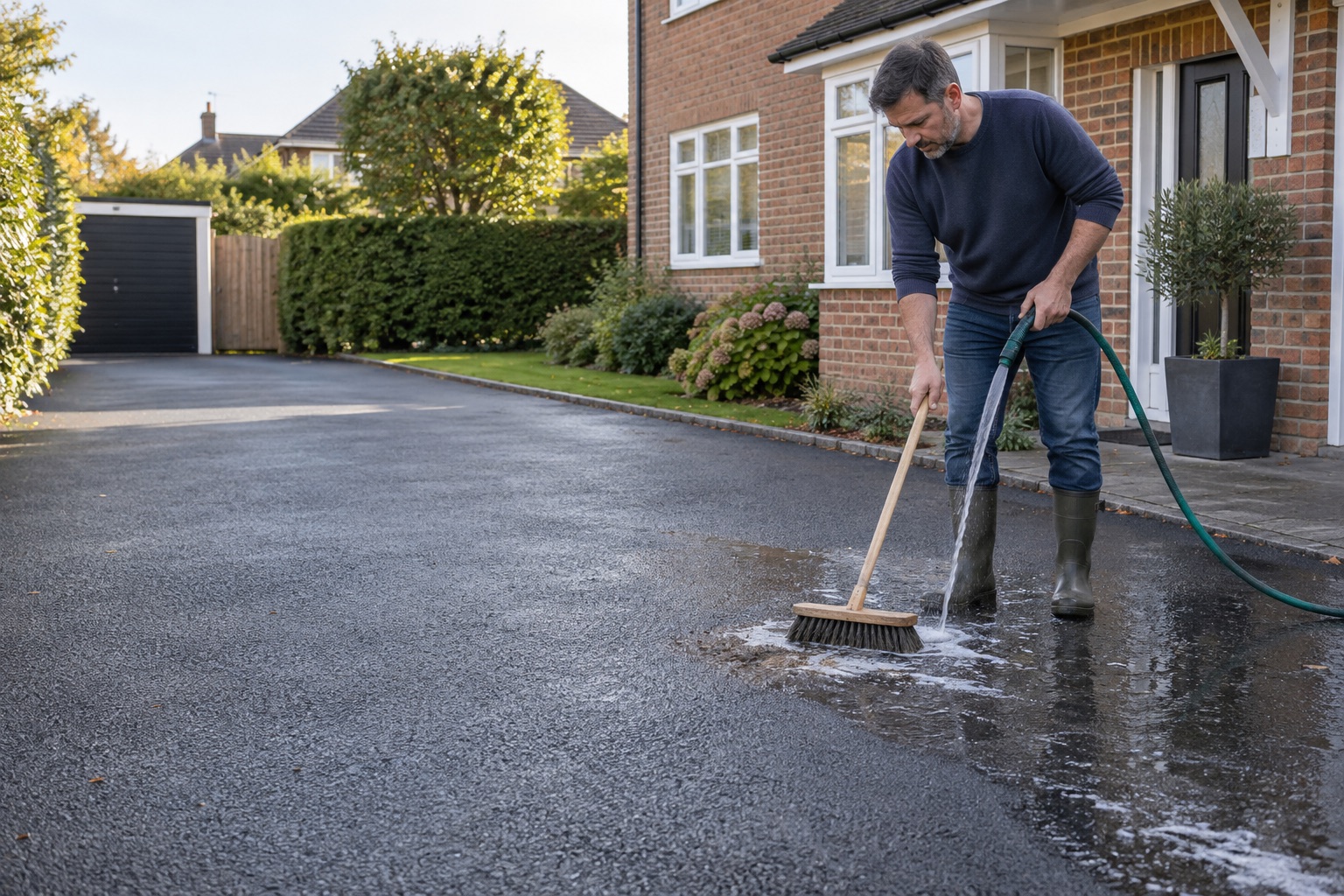
- Sweep in dry weather. Lift leaves, mud and grit with a firm non-metal broom, taking care at broken edges.
- Absorb spills. Blot fresh oil or fuel with a suitable absorbent and dispose of it correctly. Do not spread it with water.
- Test a compatible cleaner. Follow the asphalt provider’s instructions and the product label; treat only the area that needs it.
- Agitate gently. Use a brush rather than a metal scraper. Keep solvents and unlabelled chemical mixtures away.
- Rinse with low force. An ordinary hose is often enough. Collect contaminated residue instead of sending it into a surface-water drain.
Can you pressure wash tarmac?
Sometimes a sound dense asphalt driveway can be rinsed at low pressure with plenty of stand-off, but the installation provider must set the limit. Traditional pressure washing is explicitly unsuitable for some porous asphalt systems because it can force dirt deeper into the voids. Never treat one generic online pressure figure as safe for every blacktop.
If pressure is permitted, use a broad fan, the lowest effective setting and a discreet test patch. Work away from open edges and repairs. Stop at the first sign of loose stones, black slurry, surface pitting or fresh colour change.
Lower-force options
Outdoor cleaners can offer a gentler rinse
The 20-bar Bosch Fontus 18V is a self-contained outdoor cleaner rather than a mains patio washer and suits controlled rinsing where a tap is awkward. The AVA Go P40 Medium is a compact mains machine with a fixed 25-degree nozzle in its listed bundle, but its output still needs to be reduced by setup and distance to match the surface maker’s rules.
 View product on Amazon
Bosch Fontus 18V
Best for: Cars, bikes and furniture where a tap or socket is inconvenient
A wheeled cordless outdoor cleaner with a 15-litre built-in tank, adjustable output and four spray patterns. Its 20-bar pressure suits controlled rinsing rather than large-patio restoration.
What stands out
- 15-litre built-in water tank
- Four spray patterns
- Up to 60 minutes quoted with the recommended battery
Keep in mind
- The selected Amazon listing excludes battery and charger
- 20 bar is not intended for heavy paved-area cleaning
- 20 bar max
- 15 l tank
- 4 m hose
- 18 V battery
 View product on Amazon
AVA Go P40 Medium
Best for: Cars, bikes and smaller outdoor areas where storage space is tight
A genuinely compact 120-bar mains washer with an 8 m flexible hose and 390 l/h flow. The small body and stored accessories make it appealing for sheds, garages and mobile car-care setups.
What stands out
- Compact body with stored accessories
- 8 m flexible hose
- Ten-year warranty when registered under AVA's terms
Keep in mind
- No surface cleaner in the Medium bundle
- Lower flow than the mid-range corded leaders here
- 120 bar max
- 390 l/h
- 8 m hose
- Mains · 1.7 kW
Compare machine formats in power cleaner vs pressure washer. For robust mineral alternatives, use the separate concrete driveway guide.
Spills and defects need diagnosis, not more force
Fuel can soften bituminous binders, while oil may penetrate and reappear. Absorb fresh material promptly, keep ignition sources away and ask the driveway contractor which treatment is compatible. Large spills or contaminated runoff may require professional handling.
Green growth tends to recur where shade and standing water persist. Improve drainage and remove leaves rather than relying only on repeated treatment. Any biocide must be authorised for the use, applied exactly to its label and kept out of drains and watercourses.
Why the installed system controls the method
Tarmac’s aftercare for one porous asphalt system recommends brushing or vacuuming surface debris and warns that traditional pressure washing can force dirt further into the material. That is a useful reminder to find the specification for your driveway before cleaning.
Frequently asked questions
Can a pressure washer damage tarmac?
Yes. Close or concentrated spray can loosen aggregate, erode weathered binder and damage edges and repairs. Some porous systems should not be traditionally pressure washed at all.
How do I remove oil from tarmac?
Absorb a fresh spill without spreading it, then use only a treatment approved for the installed asphalt. Avoid petrol and improvised solvents.
Can I use a surface cleaner on tarmac?
Only if the driveway provider allows pressure cleaning and the surface is sound. The enclosed head does not make excessive pressure safe and can hide damage while it happens.
Why is my tarmac turning grey?
Ageing and loss of binder can expose lighter aggregate. Cleaning will not reverse structural weathering; seek repair or resurfacing advice if stone is loosening.
What is the safest way to remove moss?
Start with dry mechanical removal and correct the damp conditions. If treatment is needed, use a compatible authorised product exactly as labelled.